The Neuroscience of Decision-Making
Every day, you make countless decisions, from trivial ones like what to eat to life-changing ones like where to live. Neuroscience reveals that decision-making is not a single process in one region but a collaboration among networks that evaluate options, predict outcomes, weigh emotions and select actions.
The basic steps
Researchers often describe a decision as involving several stages:
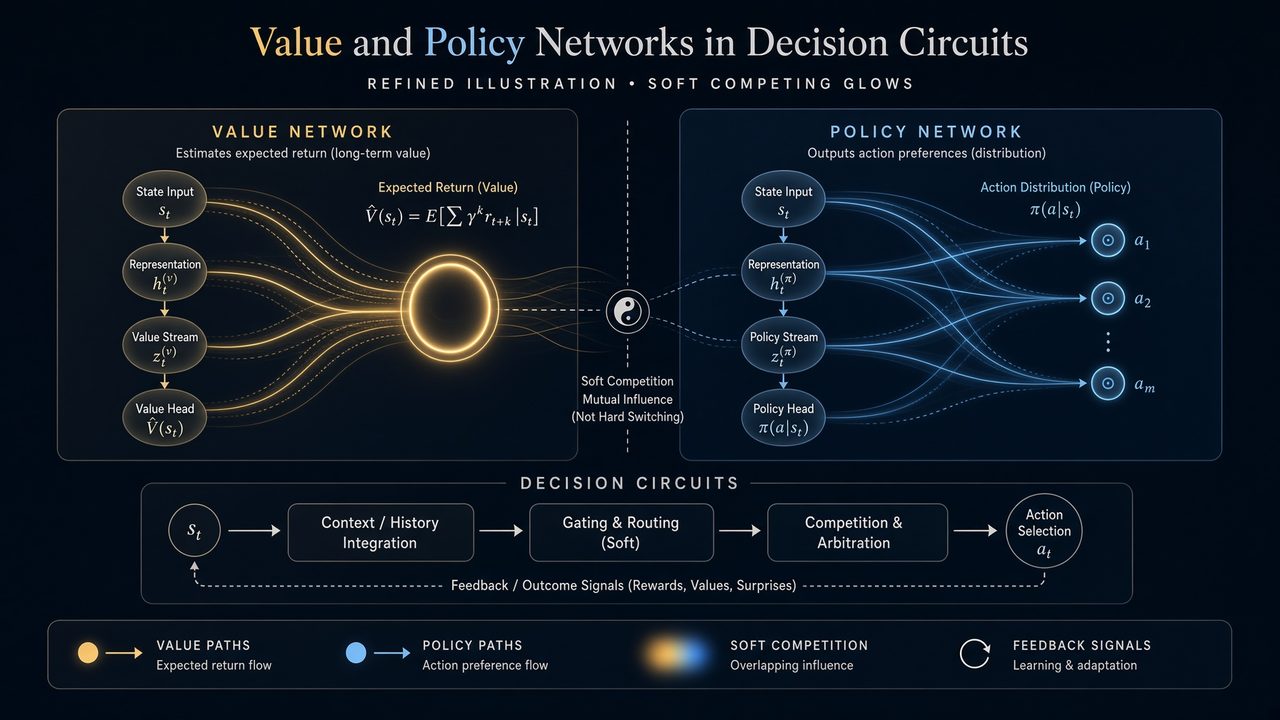
1. Representing the situation, including the options and context 2. Assigning values, estimating how good each option is 3. Selecting an action 4. Evaluating the outcome and learning, updating future values
Key brain regions
Prefrontal cortex
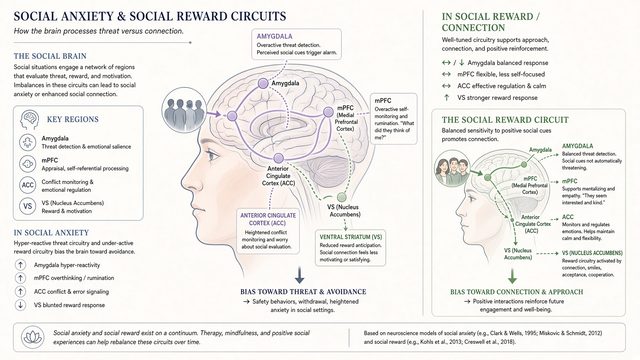
The orbitofrontal and ventromedial prefrontal cortex represent the value of options and integrate information about rewards, risks and preferences. The dorsolateral prefrontal cortex supports working memory and rule-based reasoning. The anterior cingulate cortex monitors conflict and effort.
Striatum and dopamine
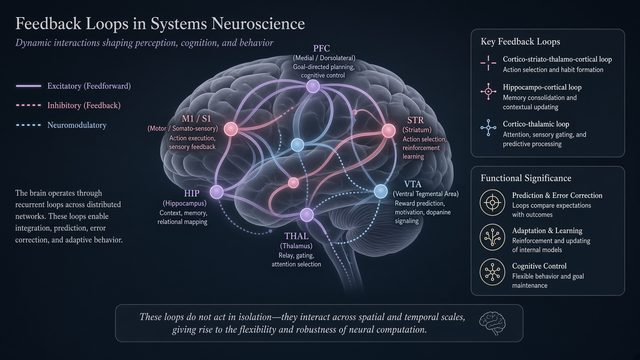
The basal ganglia, especially the striatum, are central to learning from reward and selecting actions. Dopamine neurons signal reward prediction error, the difference between what was expected and what occurred. When an outcome is better than expected, dopamine firing increases, strengthening the associated choice. When it is worse, firing dips. This learning signal is the foundation of reinforcement learning models used in both neuroscience and artificial intelligence.
Amygdala and insula
These regions contribute emotional and bodily signals. The insula tracks internal states and is active when people face uncertainty, risk or unfairness. The amygdala helps tag options with emotional significance.
Parietal cortex
Parietal regions accumulate evidence over time. In many perceptual decisions, neurons gradually build up activity until it reaches a threshold, and then a choice is made. This accumulation model explains the tradeoff between speed and accuracy.
Fast and slow thinking
Psychologists describe two modes: a fast, intuitive, habitual mode and a slower, effortful, deliberate one. Neuroscience offers a parallel in the distinction between habitual (model-free) control, which relies on striatal learning of what has worked, and goal-directed (model-based) control, which uses a mental model of consequences and depends more on prefrontal cortex. Stress and fatigue tend to push people toward habits.
Emotion is not the enemy of reason
Patients with damage to the ventromedial prefrontal cortex often have intact intelligence but make poor real-life decisions, according to work by Antonio Damasio. Emotional signals appear to guide choices by marking options as promising or dangerous. Good decision-making involves both feeling and thinking.
Predictable biases
The brain's shortcuts are efficient but can lead to systematic errors:
- Loss aversion: losses loom larger than equivalent gains
- Framing effects: the same choice described differently leads to different decisions
- Present bias: preferring smaller immediate rewards over larger later ones
- Overconfidence: overestimating the accuracy of our judgments
- Anchoring: being swayed by an arbitrary starting number
Neuroimaging links some of these biases to the interplay between reward circuits and prefrontal control regions.
Risk and uncertainty
People differ in how they respond to risk and ambiguity, influenced by genetics, age and experience. Adolescents show heightened reward sensitivity relative to prefrontal control, a pattern consistent with their greater risk taking.
Improving your decisions
- Slow down for important choices, giving deliberate systems time to engage
- Sleep on it, because fatigue degrades judgment
- Write out pros and cons to reduce framing effects
- Consider the opposite, asking why you might be wrong
- Set rules in advance for decisions where impulses are risky
- Manage stress, which shifts the brain toward habit
Disorders of decision-making
Parkinson's disease, addiction, frontal lobe injury, obsessive-compulsive disorder and depression can all alter how the brain values rewards and costs. Understanding these changes informs treatment.
Further reading from authoritative sources
- National Institute of Neurological Disorders and Stroke (NINDS)
- National Institute of Mental Health (NIMH)
This article is educational and does not replace advice from a licensed clinician. See the medical disclaimer. Looking for specialist care? Browse the neurology clinic directory.