The Neuroscience of Justice and Punishment
Humans care deeply about fairness and are willing to pay costs to punish those who violate norms. Neuroscience explores why justice feels so compelling and how punishment decisions are made.
Fairness and reward
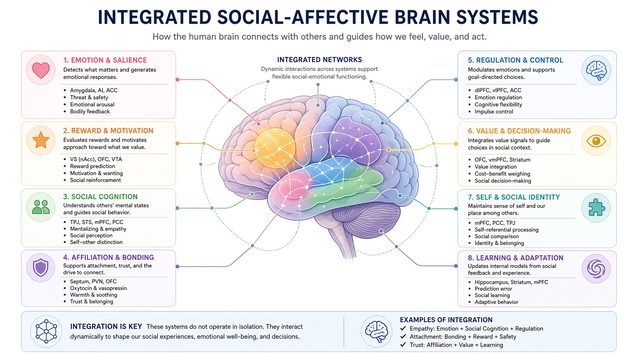
In the ultimatum game, a proposer offers a split of money, and a responder can accept or reject it, in which case both get nothing. People often reject unfair offers, even at a cost. Alan Sanfey and colleagues found that unfair offers activated the anterior insula, associated with disgust and negative emotion, and the dorsolateral prefrontal cortex, associated with control, and that insula activity predicted rejection. Fair treatment activates reward regions, and people experience satisfaction in equality, as shown in studies of inequity aversion by Elizabeth Tricomi and colleagues.
Punishing wrongdoers
Dominique de Quervain, Ernst Fehr and colleagues found that punishing a person who violated trust activated the dorsal striatum, a reward region, suggesting that punishment can feel satisfying, and that stronger activation predicted willingness to pay for punishment. Third-party punishment, in which people punish wrongdoing that does not affect them, appears across cultures and helps sustain cooperation. Joshua Buckholtz and colleagues showed that judgments about culpability and punishment recruit areas involved in reading others' intentions, such as the temporoparietal junction, and the dorsolateral prefrontal cortex, involved in assigning punishment. Disrupting the right dorsolateral prefrontal cortex with magnetic stimulation changed punishment decisions without changing judgments of blame, indicating separable processes.
Motives for punishment
People are motivated by retribution, deserved suffering, as well as deterrence, protecting society and rehabilitation. Studies by Kevin Carlsmith and others suggest that people generally punish based on desert, not deterrence, even when they say they value deterrence.
Biases
- Outcome bias: more severe consequences lead to more blame, even when intent is equal
- Group and racial bias: differences in sentencing and perceptions
- Emotion: anger increases punitiveness, while empathy for the offender reduces it
- Dehumanization: reduces concern for offenders
- Hindsight bias
Forgiveness and restorative approaches
Forgiveness involves empathy and perspective taking, and reduces anger and rumination. Restorative justice programs bring victims, offenders and communities together to repair harm and are associated with higher victim satisfaction and reductions in reoffending in some studies.
Implications for law and policy
Neuroscience raises questions about responsibility. Adolescent brains are still developing, which influenced decisions by the U.S. Supreme Court on juvenile sentencing. Conditions such as brain tumors, frontotemporal dementia and severe mental illness can affect behavior, and they are considered in some cases. Some scholars, such as Joshua Greene and Jonathan Cohen, suggest that neuroscience may shift views of retribution by showing that behavior is caused by brain processes, while others emphasize that people remain responsible agents. The law relies on practical standards for responsibility, and no brain scan can determine blame.
Justice across cultures
Cross-cultural studies by Joseph Henrich and colleagues find that norms of fairness and willingness to punish vary across societies, with larger-scale societies showing more fairness toward strangers. Justice is both biologically grounded and culturally shaped.
Questions for policy
If punishment is driven by emotion, how can legal systems encourage careful reasoning, protect against bias and support rehabilitation? Training, clear sentencing standards and attention to evidence on what reduces crime are among the answers researchers suggest.
Takeaway
The drive for justice is wired into the brain, and it can be shaped by reflection, empathy and fair institutions.
Further reading from authoritative sources
- National Institute of Neurological Disorders and Stroke (NINDS)
- National Institute of Mental Health (NIMH)
This article is educational and does not replace advice from a licensed clinician. See the medical disclaimer. Looking for specialist care? Browse the neurology clinic directory.