The Science of Consciousness: Current Theories
Consciousness, the fact that there is something it is like to see red, feel pain or hear a song, remains one of the hardest open questions in science. Neuroscientists no longer treat it as untouchable. Over the past three decades, researchers have built testable theories, designed experiments to compare them and begun to map which brain activity is associated with experience and which is not.
The core puzzle
Philosophers distinguish the "easy problems" of consciousness, such as how the brain focuses attention, integrates information and controls behavior, from the "hard problem": why any of this processing is accompanied by subjective experience at all. Most researchers work on the easy problems and on a middle path, identifying the neural correlates of consciousness, the minimal brain activity that is sufficient for a particular experience.
How researchers study it
A common method is contrasting conscious and unconscious processing of the same stimulus. In masking and binocular rivalry experiments, an image may reach the eye but go unseen. Comparing brain activity in seen and unseen trials reveals what changes when a stimulus enters awareness. Other approaches study anesthesia, sleep, coma, brain injury and disorders of consciousness, where the level or content of awareness changes.
Major theories
Global workspace theory
Proposed by Bernard Baars and developed by Stanislas Dehaene and colleagues, this theory holds that the brain has many specialized, unconscious processors. Information becomes conscious when it is broadcast widely through a network, often linked to prefrontal and parietal regions, and made available to memory, language and decision-making. Experimentally, conscious perception tends to involve a sudden, large-scale "ignition" of activity.
Integrated information theory
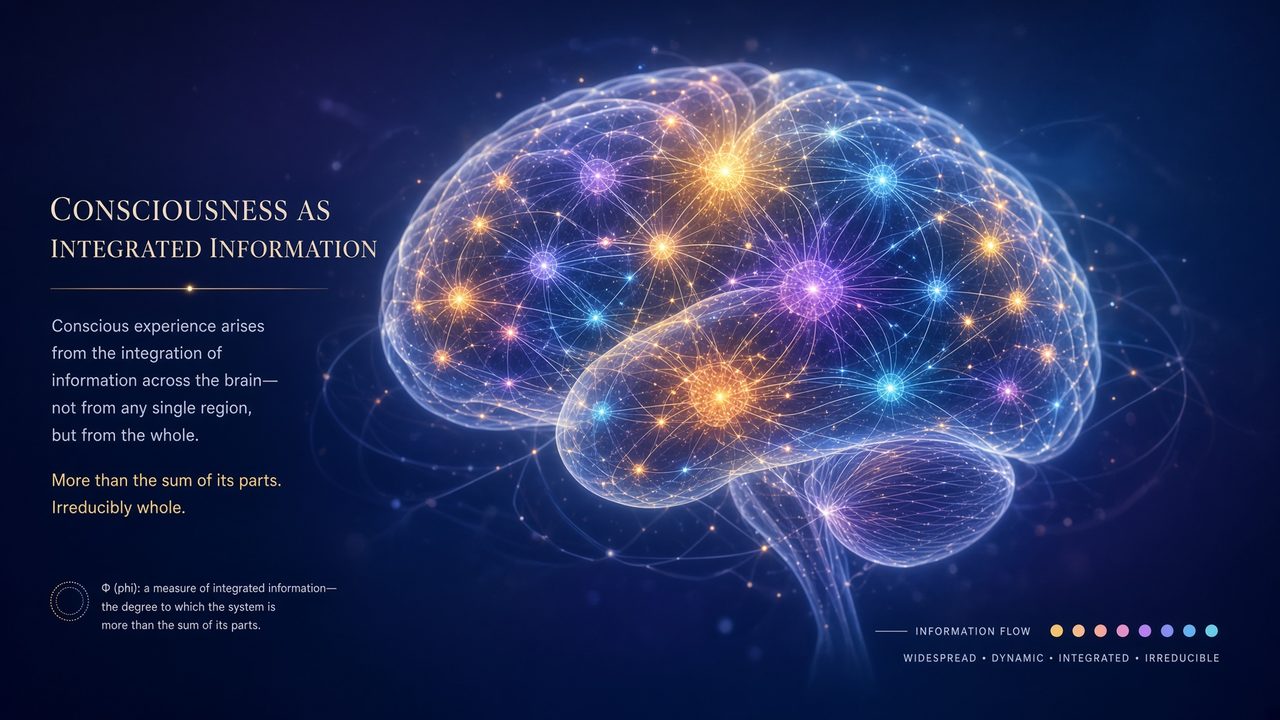
Giulio Tononi's theory begins with the properties of experience itself, that it is unified, specific and informative, and proposes that consciousness corresponds to the amount of integrated cause-effect structure in a system, measured as phi. It predicts that the posterior cortex, with its highly interconnected structure, is central to experience. The theory is mathematically ambitious and controversial, in part because it implies that consciousness could exist in non-biological systems with the right physical structure, and critics argue it is hard to test.
Higher-order theories
These propose that a mental state is conscious when the brain represents that state, in effect "knowing that it knows." Prefrontal cortex is often implicated. Critics point to evidence of experience in people with limited prefrontal function.
Recurrent processing theory
Victor Lamme and others argue that feedback loops within sensory cortex, not widespread broadcast, are the key ingredient. A stimulus becomes conscious when early visual areas and higher areas exchange signals in a loop.
Predictive processing
This family of ideas views the brain as constantly predicting its inputs, and perception as the brain's best guess about the causes of its signals. Some versions, such as those of Anil Seth, link consciousness to the brain's modeling of its own body and its regulation of internal states.
Head-to-head tests
Adversarial collaborations bring supporters of rival theories together to agree in advance on predictions, then run experiments. A prominent project from the Cogitate consortium, whose first results appeared in the 2020s, tested predictions of global workspace and integrated information theories. The outcomes challenged aspects of both, and showed that careful, preregistered tests are possible even in this field.
Clinical relevance
Understanding consciousness has practical consequences. Some people with severe brain injury appear unresponsive but show signs of awareness on EEG or fMRI tasks, a state called covert consciousness. Brain-based tests are being developed to detect it, which could change prognosis and care. Anesthesia research also benefits, as it explores how consciousness is lost and regained.
Animals and machines
Many scientists accept that mammals and likely other animals have conscious experience, a view reflected in a widely discussed declaration in 2012. Whether artificial systems could be conscious is debated, and the answer depends on which theory is right. Most researchers think today's AI systems lack the features that leading theories require, though they disagree about future systems.
What remains unknown
We do not yet know which brain mechanisms are essential, whether consciousness comes in degrees, or whether any physical theory can explain subjective experience. Progress is real, but modest. Expect this field to remain active, and be cautious about any source claiming to have solved consciousness.
Further reading from authoritative sources
- National Institute of Neurological Disorders and Stroke (NINDS)
- National Institute of Mental Health (NIMH)
This article is educational and does not replace advice from a licensed clinician. See the medical disclaimer. Looking for specialist care? Browse the neurology clinic directory.