Attention and Memory: Why Focus Matters
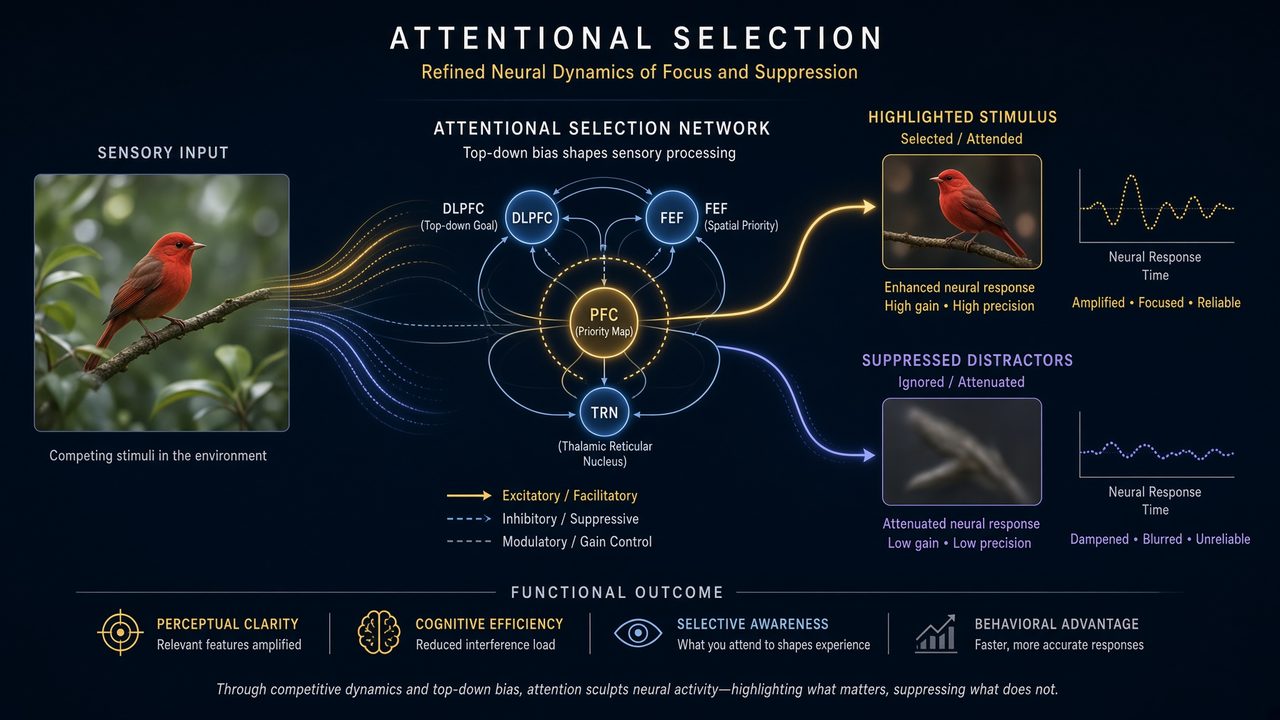
You cannot remember what you never noticed. Attention is the gateway to memory, and many everyday memory failures, like forgetting where you put your keys, are really attention failures at the time of encoding.
Attention networks
Michael Posner and Steven Petersen described three functional networks:
- Alerting: maintaining a state of readiness, involving the brainstem, thalamus and right frontal-parietal regions, with norepinephrine
- Orienting: selecting information from sensory input, involving the parietal lobe, frontal eye fields and superior colliculus, with acetylcholine
- Executive control: resolving conflict and selecting responses, involving the anterior cingulate and prefrontal cortex, with dopamine
The dorsal attention network directs attention to goals, while the ventral attention network detects unexpected, relevant events.
From attention to memory
Attention influences memory in several ways:
- Selection: attended information is processed more deeply and enters working memory.
- Encoding: attention enhances neural responses in sensory cortex and increases hippocampal and prefrontal activity associated with successful encoding. Studies show that activity at the time of learning predicts what will be remembered, a phenomenon called the subsequent memory effect.
- Depth of processing: Fergus Craik and Robert Lockhart found that thinking about meaning leads to stronger memory than attending to surface features.
- Consolidation: attention at the time of retrieval and rehearsal supports consolidation and reconsolidation.

Divided attention and multitasking
Dividing attention during learning markedly reduces later memory. Studies by Moshe Naveh-Benjamin showed that distraction at encoding impairs memory more than distraction at retrieval. Hearing a lecture while texting or checking social media produces fragmented, shallow encoding. Even the presence of a smartphone on the desk can reduce available cognitive capacity in some studies, though results are mixed. Task-switching imposes costs in time and errors, as discussed in research on "attention residue."
Inattentional blindness
In the famous "invisible gorilla" experiment by Daniel Simons and Christopher Chabris, about half of viewers counting basketball passes failed to notice a person in a gorilla suit walking through the scene. What we do not attend to may not be encoded at all, even if it is in plain sight.
When attention is impaired
- ADHD: difficulties with sustained attention and executive control affect encoding
- Anxiety and depression: intrusive thoughts and rumination consume attention
- Sleep deprivation: reduces alertness and hippocampal encoding
- Aging: reduced processing speed and divided attention capacity
- Stress and pain
- Alcohol and certain medications
- Brain injury
Ways to strengthen attention for learning
- Reduce distractions: silence notifications, close tabs, and use focus tools. Keep your phone out of sight.
- Single-task and use time blocks, such as the Pomodoro method of focused sessions with short breaks.
- Sleep well and manage stress.
- Exercise, which acutely improves attention and executive function.
- Engage actively: ask questions, summarize, draw diagrams and teach someone else.
- Take notes thoughtfully, processing meaning rather than transcribing verbatim.
- Use cues to focus, such as consistent study locations and routines.
- Practice mindfulness, which has modest but consistent benefits for attention in studies.
- Manage hunger, hydration and caffeine sensibly.
- Take breaks since sustained attention degrades with time.
- Seek evaluation for persistent attention problems, which may have treatable causes.
Memory aids when attention slips
Say aloud where you place things, make a deliberate "mental snapshot," and use routines, such as keeping keys in the same place. These strategies force attention at the moment of encoding.
Takeaway
Remembering starts with noticing. Protecting your attention is among the most effective ways to improve your memory.
Further reading from authoritative sources
- National Institute of Neurological Disorders and Stroke (NINDS)
- National Center for Complementary and Integrative Health (NCCIH)
This article is educational and does not replace advice from a licensed clinician. See the medical disclaimer. Looking for specialist care? Browse the neurology clinic directory.