Deliberate Practice and Brain Change
Not all practice is equal. Someone who plays the same easy piece for an hour is repeating, not improving. Deliberate practice, a concept developed by psychologist Anders Ericsson, is a purposeful form of training that reliably drives improvement and, over time, changes the brain.
What defines deliberate practice
- Well-defined goals: a specific aspect of performance to improve, such as a difficult passage or a particular serve
- Full attention and effort: practice is demanding and not usually enjoyable in the moment
- Immediate, informative feedback: from a coach, a recording or results
- Work at the edge of ability: tasks that are challenging but achievable, repeated and refined
- Guidance from established methods: training techniques developed by skilled teachers
- Repetition with refinement, not mindless repetition
In Ericsson's studies of violinists at a Berlin music academy, the best students accumulated more hours of solitary practice by age twenty, and did so in shorter, more focused sessions, with adequate rest and sleep.
What happens in the brain
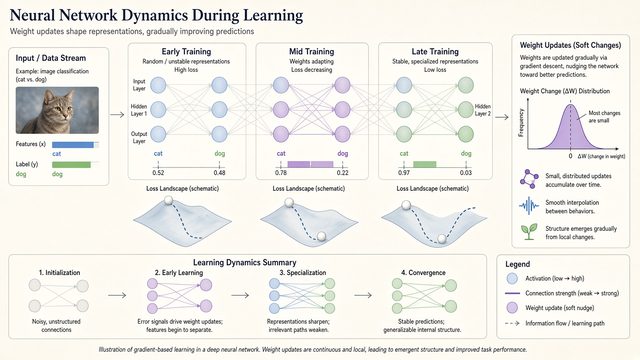
Practice that demands effort and produces errors drives several adaptive processes:
- Error signals from the cerebellum and cortex guide adjustments in motor and cognitive skills.
- Dopamine-based reward prediction errors help refine actions in the basal ganglia.
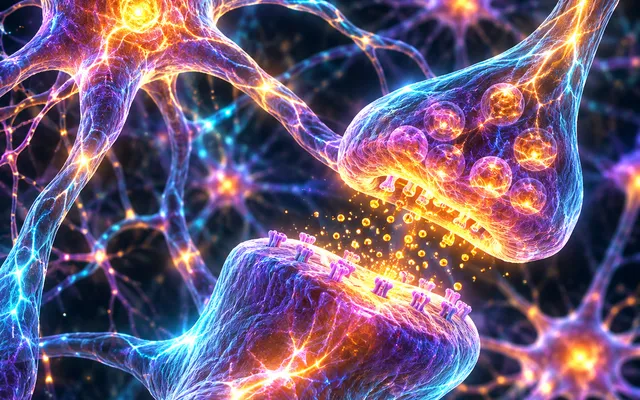
- Synaptic strengthening (long-term potentiation) and structural growth of dendritic spines follow repeated, focused activation.
- Myelination: studies suggest practice increases myelin in task-relevant pathways, speeding signals. Though popular books exaggerate this, evidence supports a role for activity-dependent myelination.
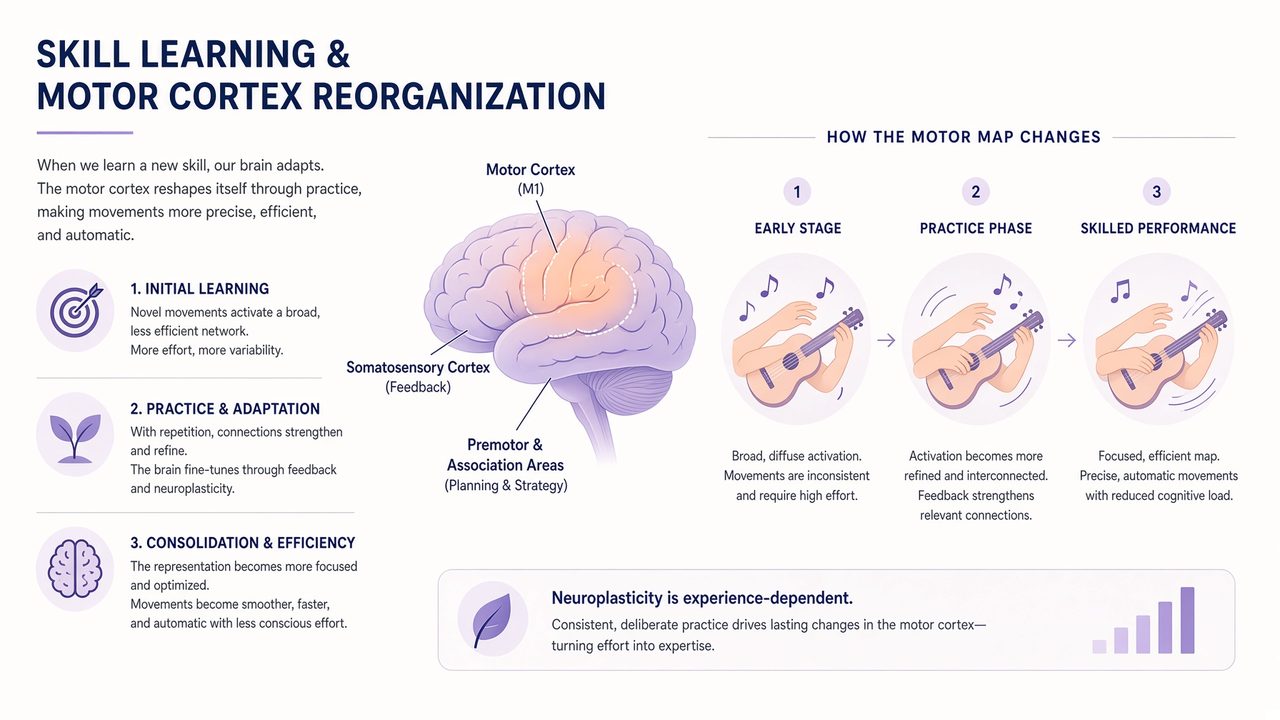
- Cortical remapping: representations of trained fingers or sounds expand.
- Prefrontal engagement during early learning gives way to more efficient, automatic circuits.
- Sleep consolidation strengthens gains after practice.

The role of struggle
Robert Bjork's concept of desirable difficulties holds that conditions that slow initial learning, such as spacing, variability and testing, often improve long-term retention. If practice feels smooth, you may not be pushing hard enough. Errors are informative, as long as you receive feedback and can correct them.
Limits of the concept
Critics note that deliberate practice is not the only factor in expertise. Meta-analyses by Brooke Macnamara and colleagues found that deliberate practice explained about 26 percent of variance in games, 21 percent in music, 18 percent in sports and only about 1 percent in professions, though definitions and measures vary. Starting age, quality of instruction, working memory and other traits also contribute. The practical lesson is not that practice is unimportant, but that more practice of the right kind helps everyone improve.
How to design deliberate practice
1. Choose a narrow target, such as "reduce errors in bars 12 to 16." 2. Set a measurable goal, like playing it at tempo three times in a row. 3. Focus fully, removing distractions. Keep sessions to about 20 to 60 minutes, with breaks. 4. Get feedback from a teacher, a recording, video analysis or data. 5. Slow down and isolate difficult parts, then reintegrate. 6. Vary conditions to promote transfer. 7. Test yourself in realistic conditions, including performing for others. 8. Reflect and adjust: note what worked and what to change next time. 9. Rest, sleep and avoid overtraining, since fatigue reduces quality and risks injury. 10. Maintain motivation with a mix of challenge and meaningful milestones.
Applying it beyond sport and music
Medical students can practice diagnosis with case reviews and feedback. Writers can revise with targeted critique. Professionals can seek stretch assignments and structured mentoring. Even everyday skills like public speaking benefit from recorded practice and evaluation.
Takeaway
Deliberate practice transforms hours into progress. By focusing effort, seeking feedback and embracing difficulty, you give the brain the signals it needs to change.
Further reading from authoritative sources
- National Institute of Neurological Disorders and Stroke (NINDS)
- National Center for Complementary and Integrative Health (NCCIH)
This article is educational and does not replace advice from a licensed clinician. See the medical disclaimer. Looking for specialist care? Browse the neurology clinic directory.