Metacognition: Knowing How You Think
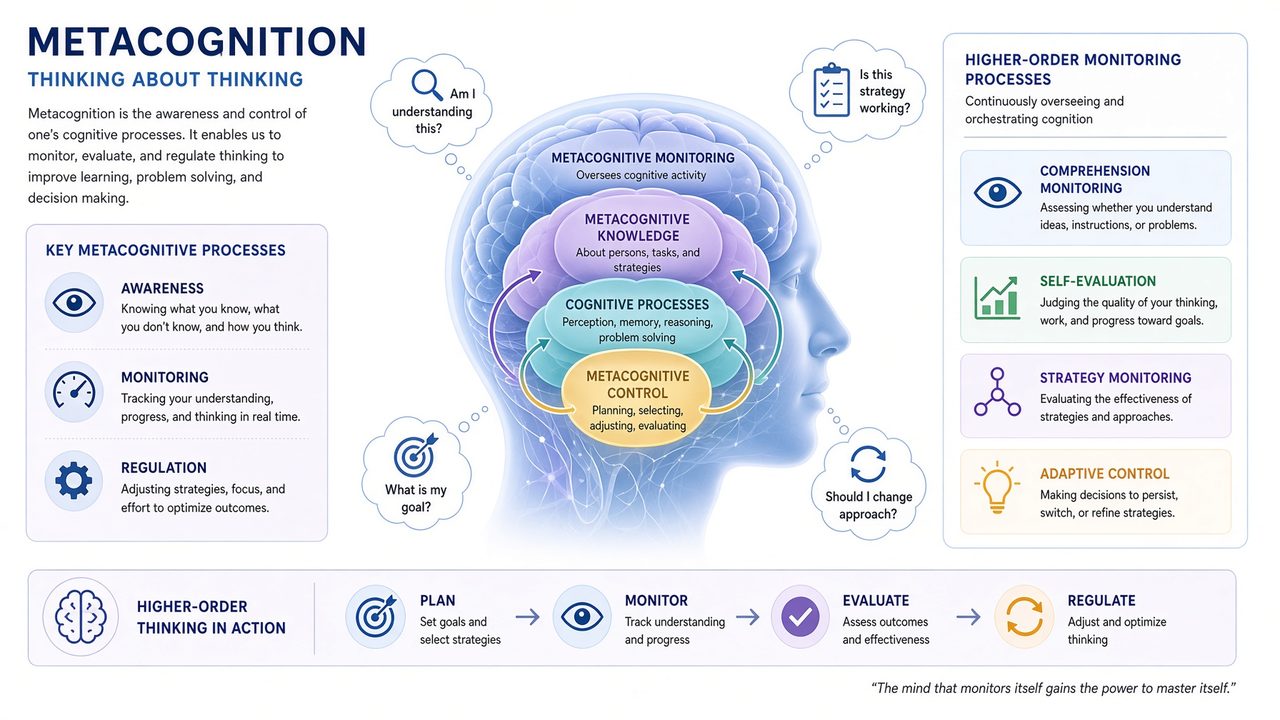
Have you ever felt sure you understood a chapter, only to blank on the exam? Or realized mid-sentence that you were not making sense? These moments reflect metacognition, the ability to monitor and control your own thinking. It is a key ingredient in effective learning and decision-making.
Two components
John Flavell, who introduced the term in the 1970s, described:
- Metacognitive knowledge: understanding of how learning works, including your own strengths and weaknesses and which strategies fit which tasks
- Metacognitive regulation: planning, monitoring and evaluating your thinking in real time
Related concepts include judgments of learning (predicting future recall), feeling of knowing (sensing that you know something even if you cannot retrieve it), confidence ratings and error monitoring.
Brain basis
Neuroimaging and lesion studies by Stephen Fleming, Raymond Dolan and others show that metacognitive accuracy, the correspondence between confidence and actual correctness, relates to:
- Anterior prefrontal cortex (frontopolar region, BA10): the volume and white matter integrity in this region predict individual differences in metacognitive ability.
- Medial prefrontal cortex and anterior cingulate: monitoring performance and conflict.
- Insula: awareness of internal states.
- Precuneus and parietal regions: confidence-related activity.
Interestingly, metacognitive ability is partly separable from task performance. Two people can be equally accurate on a task but differ in how well their confidence tracks accuracy.

Why we misjudge
- Illusion of knowing: familiarity, such as re-reading notes, feels like understanding. Studies by Nate Kornell, Robert Bjork and others show that students often prefer less effective strategies, like re-reading and highlighting, because they feel fluent.
- Dunning-Kruger effect: people with low skill in a domain tend to overestimate their performance, since the skills needed to perform well are also needed to judge performance. Results vary by task, and the effect can partly reflect statistical artifacts.
- Overconfidence: common in many domains.
- Hindsight bias: after learning an answer, we think we knew it all along.
Metacognition and learning
Research consistently shows that students who plan, monitor and evaluate their learning achieve better results. John Hattie's synthesis ranks metacognitive strategies among the more effective educational interventions. Teaching students to ask themselves questions, such as "Do I understand this? How could I test myself?", improves outcomes, particularly for struggling learners.
Development and aging
Metacognitive skills emerge in early childhood and develop through adolescence alongside prefrontal maturation. In older adults, metacognitive accuracy may decline in some domains, and is affected in dementia, where anosognosia (lack of awareness of deficits) can occur. Metacognitive deficits are also seen in schizophrenia, brain injury, ADHD and some addictions.
Improving metacognition
- Test yourself and check answers instead of re-reading. The gap between predicted and actual performance trains calibration.
- Make predictions: estimate your score before a quiz, then compare.
- Use delayed judgments: judging learning after a delay is more accurate than immediately after studying.
- Explain concepts in your own words, or teach them, to expose gaps.
- Ask planning questions before a task: What is my goal? What strategy will I use? What could go wrong?
- Monitor during tasks: pause to ask "Am I following this?"
- Reflect after: What worked? What would I change?
- Keep a learning journal or error log.
- Seek feedback from teachers, peers or objective measures.
- Practice mindfulness, which has been linked to improved awareness of mental states and some evidence for improved metacognitive accuracy.
- Think about thinking during decisions: consider alternative views and the strength of your evidence.
Metacognition in everyday life
Metacognition helps in recognizing when you are distracted, tired, biased or emotionally reactive, and adjusting accordingly. In therapy, metacognitive therapy and mindfulness-based approaches teach people to observe thoughts as mental events rather than facts, helping with rumination and anxiety.
Takeaway
Thinking about thinking is a learnable skill. By testing yourself, reflecting honestly and adjusting strategies, you can turn effort into more effective learning.
Further reading from authoritative sources
- National Institute of Neurological Disorders and Stroke (NINDS)
- National Center for Complementary and Integrative Health (NCCIH)
This article is educational and does not replace advice from a licensed clinician. See the medical disclaimer. Looking for specialist care? Browse the neurology clinic directory.