Music and Memory: Why Songs Stick in Our Heads
A few notes of a song can transport you to a summer long ago, and a tune you heard once at the supermarket can loop in your head all day. Music and memory are tightly linked, and the connection has implications for learning, emotion and therapy.
Why music is memorable
- Structure: repeating melody, rhythm and rhyme create predictable patterns that the brain can chunk and predict.
- Emotion: music activates the amygdala, nucleus accumbens and other reward regions, and releases dopamine, which supports memory consolidation.
- Movement: rhythm engages motor systems, even in listeners who are still.
- Multimodal encoding: words, melody and movements form multiple retrieval cues.
- Repetition: songs are heard many times, often in meaningful contexts.
Earworms
An earworm, or involuntary musical imagery, is a snippet of music that repeats spontaneously. Surveys suggest that most people experience them weekly. Earworms tend to be songs with simple, repetitive melodies, an upbeat tempo and some unusual interval, and they are often triggered by recent exposure or association, stress or boredom. They involve auditory cortex, the motor planning regions, and frontal areas. Strategies to dispel them include chewing gum, which disrupts subvocal rehearsal, listening to the entire song, engaging in an absorbing task such as solving anagrams, or listening to another tune.

Music and autobiographical memory
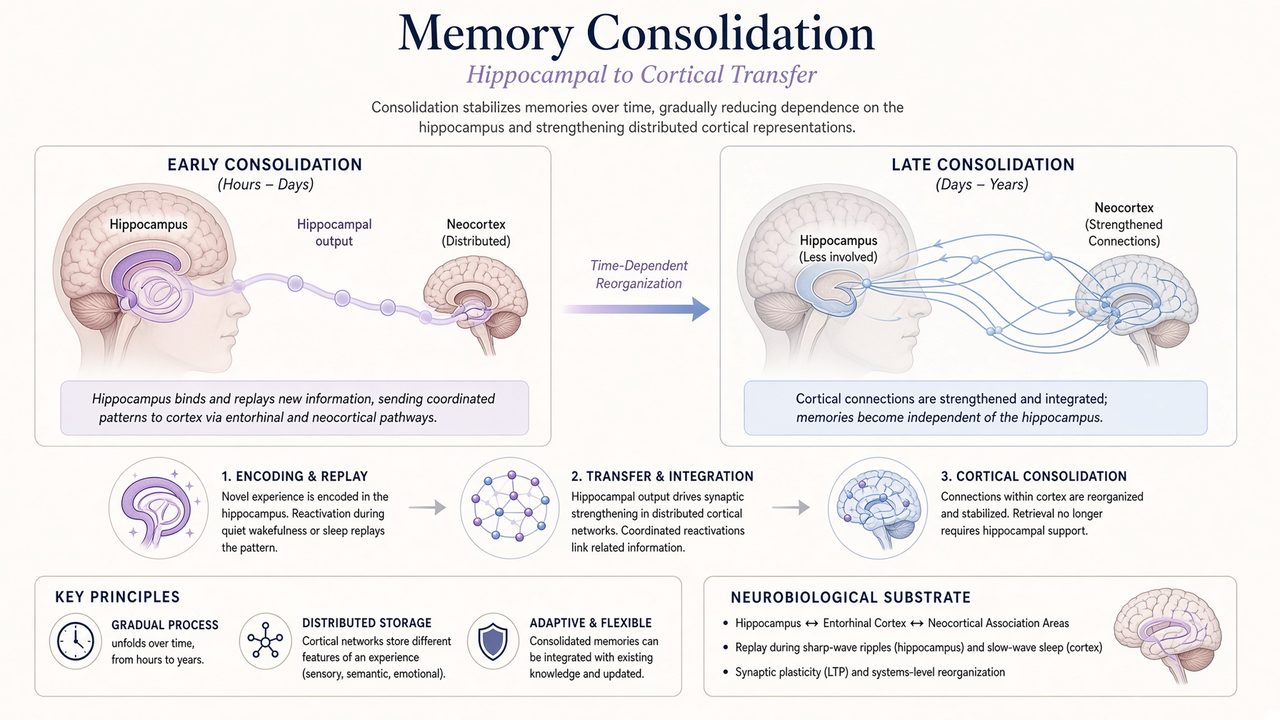
Songs from adolescence and early adulthood are remembered especially strongly, a phenomenon called the reminiscence bump. Hearing them evokes vivid autobiographical memories with emotions attached. Brain imaging by Petr Janata found that the medial prefrontal cortex, a region involved in self-referential processing, tracks the familiar music and links it to personal memories. This region is relatively spared early in Alzheimer's disease, which may explain why people with dementia can still respond to familiar songs.
Music as a memory aid
- Jingles and songs help children learn the alphabet, math facts or country lists.
- Mnemonic songs are used in education and by medical students.
- Oral traditions across cultures use rhythm and melody to carry long texts.
- Studies show that setting words to a melody can improve recall, especially if the tune is simple and the words are not too complex, though results vary.
- Background music while studying can help or hinder, depending on the task and the person. Music with lyrics often interferes with reading and writing tasks.
Music therapy and dementia
Studies suggest that personalized playlists can reduce agitation, improve mood and evoke memories in people with dementia, and group singing can support social engagement. Evidence for improving cognition is modest, and effects are mainly on behavior and quality of life. The documentary-popularized "Music and Memory" programs use individualized playlists, and clinical trials show benefits in some care settings.
Music and other conditions
- Stroke and aphasia: melodic intonation therapy uses singing to help people produce words, using right-hemisphere pathways.
- Parkinson's disease: rhythmic cues improve gait.
- Children: musical training is associated with improved auditory processing and, in some studies, language skills, though causal claims about general intelligence are debated.
Using music well
- Create playlists for specific memories or moods.
- Use music for pacing exercise and routines.
- Learn an instrument at any age for lifelong cognitive engagement.
- Sing together to support social connection.
- Consider personalized music for older relatives with memory loss, choosing songs from their youth.
Takeaway
Music holds memory in a unique way, combining emotion, movement and pattern. Its power makes it a valuable tool for learning and for connection across the lifespan.
Further reading from authoritative sources
- National Institute of Neurological Disorders and Stroke (NINDS)
- National Center for Complementary and Integrative Health (NCCIH)
This article is educational and does not replace advice from a licensed clinician. See the medical disclaimer. Looking for specialist care? Browse the neurology clinic directory.