Procedural Memory: Why You Never Forget How to Ride a Bike
After years without cycling, most people can hop on a bike and ride. The knowledge lives in procedural memory, the system for skills and habits that you perform automatically rather than consciously describe.
What procedural memory covers
- Motor skills, like swimming, playing piano and tying shoes
- Perceptual and cognitive skills, like reading and mirror-reading
- Habits and routines, like your morning sequence
- Some forms of conditioning
It is a type of implicit memory: you show it by doing, and it is hard to put into words. Try explaining exactly how you keep your balance on a bicycle.
The brain systems
Basal ganglia
The striatum, a major part of the basal ganglia, is crucial for learning habits and sequences through reward-based feedback. Dopamine signals help strengthen successful action patterns. Parkinson's disease, which involves loss of dopamine neurons, impairs the initiation and learning of movements.
Cerebellum
It fine-tunes timing and accuracy through error correction and adapts movements to new conditions.
Motor cortex and supplementary motor areas
They plan and execute movement sequences and reorganize with practice. Training can expand the cortical area devoted to practiced movements.

Stages of skill learning
1. Cognitive stage. Performance is slow and error-prone, and requires attention and explicit instruction. 2. Associative stage. Movements become smoother, and errors decline. 3. Autonomous stage. The skill is largely automatic, using less attention, freeing the mind for other things.
Brain activity shifts accordingly, from prefrontal-heavy to more striatal and cerebellar patterns.
Why these memories last
Because procedural memory does not depend on the hippocampus, it can remain intact when explicit memory fails. Patient H.M., who could not form new conscious memories, nevertheless improved at a mirror-tracing task across days without remembering practicing it. People with Alzheimer's disease can often retain musical or motor skills longer than recent events.
Sleep and consolidation
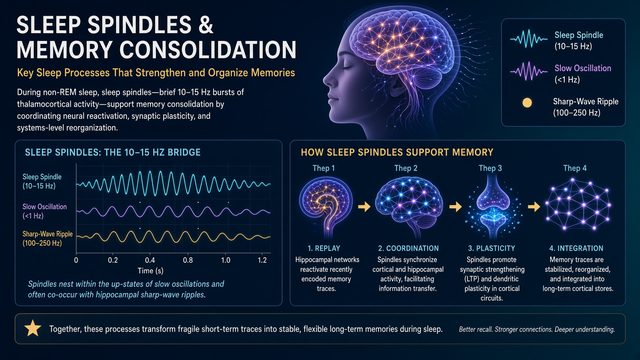
Sleep, including both deep sleep and REM, helps consolidate motor skills. People often perform better on a learned finger-tapping sequence after a night's sleep than after the same time awake.
Practicing effectively
- Practice regularly in short sessions, since distributed practice beats cramming.
- Get feedback on errors.
- Vary your practice conditions, which improves flexibility.
- Slow down at first, emphasizing accuracy.
- Use mental rehearsal, which activates overlapping motor circuits.
- Sleep after learning.
Habits, good and bad
The same system that lets you play a song also supports habits like checking your phone. Because habits are driven by cues and rewards, changing them requires altering cues, substituting new routines and making rewards immediate.
Rehabilitation implications
After a stroke or brain injury, repetitive task-specific practice harnesses procedural learning to rebuild movement. Parkinson's patients benefit from external cues, such as rhythm, which can bypass impaired internal timing.
The bottom line
Skills are written into the brain's motor and habit circuits through repetition. That is why they resist forgetting and why consistent practice is the best way to learn them.
Further reading from authoritative sources
- National Institute of Neurological Disorders and Stroke (NINDS)
- National Center for Complementary and Integrative Health (NCCIH)
This article is educational and does not replace advice from a licensed clinician. See the medical disclaimer. Looking for specialist care? Browse the neurology clinic directory.