The Neuroscience of Flow States
Musicians, athletes, programmers and writers describe moments when time seems to disappear, effort feels smooth and performance peaks. Psychologist Mihaly Csikszentmihalyi named this state flow. Neuroscientists are beginning to understand what happens in the brain, though many ideas remain preliminary.
Features of flow
Csikszentmihalyi, studying artists, chess players and rock climbers, identified common features:
- Challenge-skill balance: the task is demanding but achievable
- Clear goals
- Immediate feedback
- Deep concentration on the present
- Sense of control
- Loss of self-consciousness
- Altered sense of time
- Intrinsic reward: the activity is enjoyable in itself, called autotelic experience
What the brain may be doing
Research on flow is challenging because it is hard to measure during real activity, and findings are tentative. Proposed mechanisms include:
- Transient hypofrontality: Arne Dietrich proposed that flow involves temporary down-regulation of the prefrontal cortex, reducing self-monitoring and inner critic activity, which allows implicit, automatic processing to dominate. Evidence is mixed, and other studies suggest that parts of the prefrontal cortex remain active.
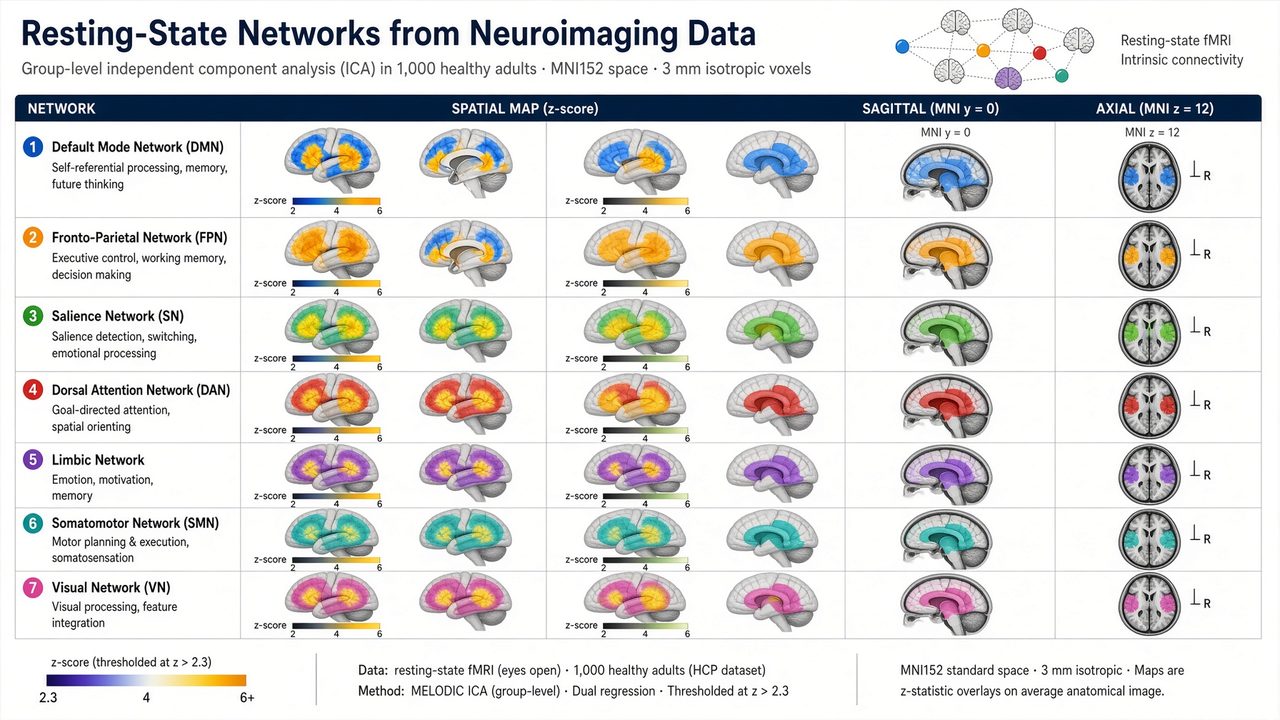
- Default mode network deactivation: reduced self-referential thinking and mind wandering.
- Attention networks: strong engagement of frontoparietal and salience networks.
- Brain rhythms: EEG studies of musicians, golfers, and gamers show increased frontal theta and alpha activity during flow-like states, consistent with relaxed focus. Studies of jazz improvisation find activity changes in the medial prefrontal cortex and deactivation in the dorsolateral prefrontal cortex.
- Neurochemistry: dopamine, norepinephrine, endorphins, anandamide and serotonin are speculated to contribute, but human evidence is limited and popular claims about a "neurochemical cocktail" outpace data.
- Striatum and reward: the intrinsic reward of flow may involve dopaminergic reward circuits.
Benefits
Research associates flow with higher performance in work, sports and music, greater enjoyment and life satisfaction, and more engagement in learning. Studies in education and at work show that flow experiences relate to creativity and skill growth. These are correlations, and some studies rely on self-reports.
Limits and cautions
- Flow can occur in harmful pursuits such as gambling or video games, and can lead to neglect of other needs.
- Not all excellent performance involves flow, and flow does not guarantee quality.
- Some people experience flow more readily than others. Traits such as conscientiousness and openness are associated.
- Conditions like ADHD can involve "hyperfocus," a related state that may be hard to control.
How to cultivate flow
- Choose activities you find meaningful or enjoyable.
- Calibrate challenge: aim for tasks slightly above your current skill. If it is too easy you will get bored, and if too hard you will get anxious. Increase difficulty as you improve.
- Set clear, specific goals for each session.
- Build in feedback: use metrics, a mentor, recordings or progress trackers.
- Eliminate distractions, silencing devices and blocking out uninterrupted time of at least 30 to 90 minutes.
- Start with a ritual that signals focus, and warm up to ease the transition.
- Prepare well, since skills must be automatized.
- Rest and sleep, because fatigue interferes.
- Practice mindfulness to improve concentration.
- Do not chase flow too hard: self-monitoring can interrupt it.
- Avoid overreliance on flow for tasks that are not naturally engaging. Use structure and discipline too.
Flow at work and school
Managers and teachers can support flow by providing autonomy, clear goals, appropriate challenge and uninterrupted time, and by avoiding micromanagement and frequent interruptions.
Takeaway
Flow is a rewarding state of deep engagement that emerges from the right match of challenge, skill and focus. While the neuroscience is still unfolding, the conditions that foster it are within reach.
Further reading from authoritative sources
- National Institute of Neurological Disorders and Stroke (NINDS)
- National Center for Complementary and Integrative Health (NCCIH)
This article is educational and does not replace advice from a licensed clinician. See the medical disclaimer. Looking for specialist care? Browse the neurology clinic directory.