The Neuroscience of Reading: How the Brain Decodes Text
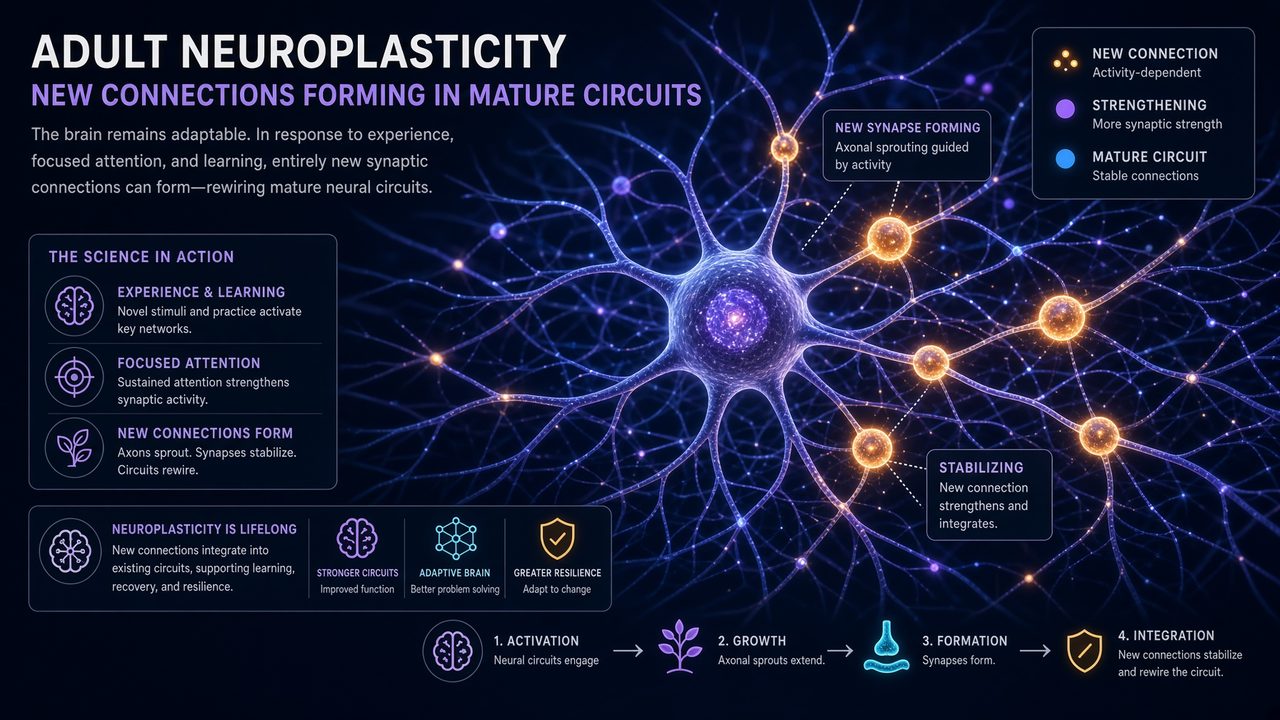
Humans have been writing for only about five thousand years, far too short for evolution to produce a dedicated reading organ. Instead, reading recycles circuits for vision, spoken language and memory. Understanding this explains why reading must be taught, and why it sometimes goes awry.
The reading network
- Visual cortex (occipital lobe): processes letter shapes and lines.
- Visual word form area (left fusiform gyrus): specializes with literacy in recognizing letter strings rapidly. Stanislas Dehaene has described this as "neuronal recycling," in which a region originally suited to object and face recognition is repurposed.
- Left temporoparietal regions (supramarginal and angular gyri, posterior superior temporal): map letters onto sounds (phonology) and connect to word meaning.
- Left inferior frontal gyrus (Broca's area): supports articulation, phonological working memory and some semantic selection.
- Left middle and inferior temporal regions: access word meanings.
- Cerebellum: automaticity and timing.
Skilled readers use two main routes. The dorsal (phonological) route sounds words out letter by letter, which is important for new or unfamiliar words, and the ventral (lexical) route recognizes familiar words as whole units, supporting fluent reading.
How reading develops
Phonological awareness, the ability to hear and manipulate the sounds in words, is a strong predictor of early reading success. Children progress from learning letter-sound correspondences to decoding to automatic word recognition. Brain imaging shows that the visual word form area becomes more selective, and the connections between visual and language regions strengthen, as children learn. Adults who learn to read show similar changes, including in early visual cortex and thalamus. Reading acquisition also changes speech processing, enhancing awareness of phonemes.

Dyslexia
Developmental dyslexia affects roughly 5 to 10 percent of people, and involves unexpected difficulty with accurate and fluent word reading despite adequate instruction and intelligence. Imaging studies often find reduced activation in left temporoparietal and occipitotemporal regions, and weaker connectivity along the arcuate fasciculus, though these findings vary. The core problem for most people is in phonological processing, and genetic factors contribute. Dyslexia is not related to intelligence or effort, and can be present in any language, though languages with irregular spelling, like English, make it more apparent.
Early identification and structured, explicit, multisensory instruction in phonics can improve outcomes, and imaging studies show that effective intervention increases activation in typical reading regions.
Reading and the digital age
Studies suggest that people may comprehend long, complex texts slightly better on paper than on screens, and that skimming habits can carry over. Research on reading in the digital age is evolving, and benefits depend on the task and the reader. Maryanne Wolf has voiced concern about the loss of "deep reading," which involves sustained attention, inference and reflection.
Supporting readers
- Read aloud to children from infancy, which builds vocabulary and story knowledge.
- Teach phonological awareness and phonics explicitly in early schooling.
- Provide lots of practice with engaging books at the right level.
- Watch for warning signs such as difficulty rhyming, persistent letter reversals after age 7, slow or inaccurate reading and spelling problems, and seek evaluation.
- Use technology such as audiobooks and text-to-speech as supports, not replacements for building decoding skills.
- Encourage reading for pleasure, which builds vocabulary and knowledge.
- Adults: reading regularly and seeking learning resources if literacy is a challenge, since adult learning is possible and effective.
Takeaway
Reading is a cultural invention that rewires the brain. Understanding how it works helps parents and teachers support every reader, including those who struggle.
Further reading from authoritative sources
- National Institute of Neurological Disorders and Stroke (NINDS)
- National Center for Complementary and Integrative Health (NCCIH)
This article is educational and does not replace advice from a licensed clinician. See the medical disclaimer. Looking for specialist care? Browse the neurology clinic directory.