From Lab to Clinic: The Science Behind Neurofeedback
Neurofeedback did not start in a wellness clinic. Its roots lie in decades of laboratory experiments on conditioning, brain rhythms and epilepsy. Tracing that path helps in judging what has been demonstrated and what remains uncertain.
Early foundations
- 1924: Hans Berger recorded the first human EEG and described alpha waves.
- 1930s to 1950s: Operant conditioning, developed by B.F. Skinner, showed that rewarded behavior increases.
- 1958: Joe Kamiya at the University of Chicago taught subjects to recognize and then control their alpha rhythm, reporting that they could shift states on request. This is often cited as the origin of EEG biofeedback.
- 1960s: Barry Sterman studied cats trained to produce a sensorimotor rhythm, a 12-15 Hz pattern over motor cortex, in exchange for food. Later, those cats resisted seizures induced by a chemical, a discovery made when they were used in an unrelated toxicology study. Sterman then showed that some people with epilepsy reduced seizures after training.
- 1970s: Alpha training became popular in the counterculture, leading to hype and to disappointment when early claims about states of enlightenment were not borne out.
- 1970s to 1980s: Joel Lubar adapted training for children with attention problems, using theta suppression and beta enhancement.
- 1990s: Slow cortical potential training developed in Germany by Niels Birbaumer for epilepsy, and later ADHD.
- 2000s: Real-time fMRI neurofeedback emerged, allowing targeted training of specific brain regions. Neurofeedback also became widespread in private practice.
Standards and research quality
Professional bodies formed in the 1990s and 2000s, including the Biofeedback Certification International Alliance (BCIA) and the Association for Applied Psychophysiology and Biofeedback. Efficacy ratings by the AAPB and the International Society for Neurofeedback and Research (ISNR) rate ADHD training as efficacious for some protocols (level 3 "probably efficacious" or higher), though independent reviewers are more cautious.
Key trials
- Several randomized trials in ADHD, including a multi-site European trial (the ADHD-NF study) and a trial comparing neurofeedback with methylphenidate, show benefit similar to nonspecific control training in some analyses, and benefit at follow-up in others.
- Studies of slow cortical potential training in epilepsy report reductions in seizures, though sample sizes are small.
- Randomized studies in PTSD, depression and insomnia are mostly small, with mixed controls.
Reviewers highlight problems: inconsistent protocols, small samples, inadequate blinding, and variability in how much people learn to control the signal. Some people, perhaps a significant minority, do not learn to modulate their targeted activity, so-called non-responders.
From laboratory insight to practical use
The clinical process generally includes:
- Assessment: history, symptom ratings, and sometimes qEEG.
- Protocol selection: choosing targets and frequencies, which vary by practitioner.
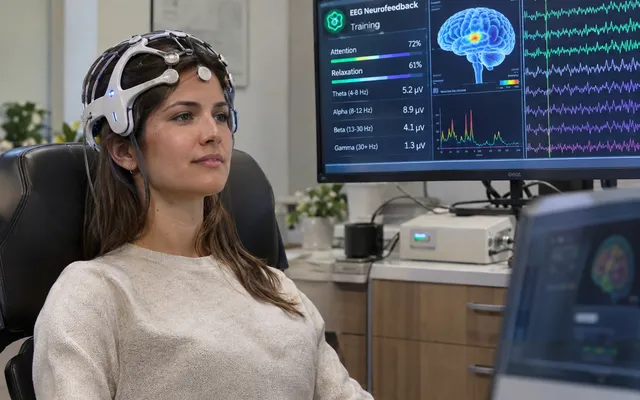
- Training: typically 30 to 60 minute sessions, twice a week.
- Monitoring: regular measures of symptoms and brain markers.
- Transfer: practicing the learned state in daily life, often with breathing or mindfulness skills.
Open scientific questions
- Which protocols work for which people?
- How much is specific brain training versus general learning effects?
- How long do the benefits last, and do boosters help?
- Can brain markers predict who will respond?
- What are the best control conditions?
- Can home devices achieve the same results as clinic systems?
Reading claims critically
A reasonable reader looks for randomized controlled trials with credible controls, independent replication, reporting of non-responders, and long-term follow-up. Testimonials, before-and-after brain maps and company-sponsored studies have limited value on their own.
Takeaway
Neurofeedback's history shows genuine science and sometimes premature enthusiasm. It is best viewed as a promising, evolving technique that works best with realistic expectations and guided by qualified clinicians.
Further reading from authoritative sources
- National Institute of Neurological Disorders and Stroke (NINDS)
- National Center for Complementary and Integrative Health (NCCIH)
This article is educational and does not replace advice from a licensed clinician. See the medical disclaimer. Looking for specialist care? Browse the neurology clinic directory.