Glial Cells: The Unsung Heroes of the Nervous System
For a long time, neurons got all the credit. Glial cells, from the Greek for "glue," were thought to be passive filler. We now know that glia are essential partners, performing functions that neurons depend on. Estimates suggest that the human brain contains roughly as many glial cells as neurons, rather than the often-quoted ten to one.
The major types
Astrocytes
Star-shaped cells that:
- Support the blood-brain barrier by wrapping their endfeet around blood vessels
- Regulate the chemical environment, absorbing excess neurotransmitters such as glutamate and potassium
- Supply energy, delivering lactate to neurons
- Shape synapses, helping form and prune them
- Modulate neural signaling through calcium waves and release of molecules called gliotransmitters
- Respond to injury by forming a scar, called gliosis
A single astrocyte can contact hundreds of thousands of synapses.
Oligodendrocytes
They produce myelin in the central nervous system, wrapping axons in insulation that speeds signal conduction. One oligodendrocyte can myelinate segments of several axons. Myelin is damaged in multiple sclerosis. In the peripheral nervous system, Schwann cells perform this job.
Microglia
The immune cells of the brain, microglia constantly survey their surroundings. They:
- Clear debris and dead cells
- Prune synapses during development
- Fight infection
- Release inflammatory signals after injury
Overactive microglia are implicated in neurodegenerative diseases, and many Alzheimer's risk genes are expressed in microglia.
Ependymal cells
They line the ventricles and produce and circulate cerebrospinal fluid using tiny hairlike cilia.
Radial glia and neural stem cells
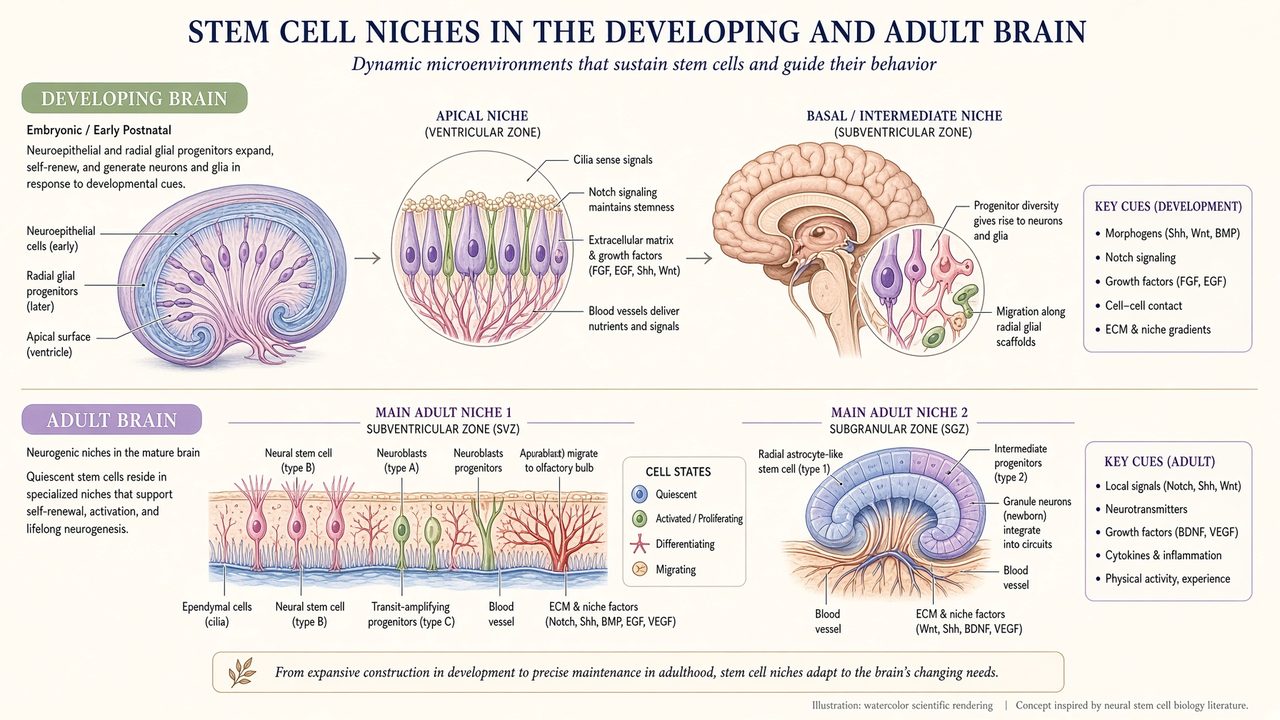
During development, radial glia guide migrating neurons and act as progenitors that generate neurons and other glia. In certain adult regions, glial-like cells retain stem cell properties.
Oligodendrocyte precursor cells
Also called NG2 glia, they remain throughout life and can generate new oligodendrocytes, contributing to myelin repair and plasticity.
Glia and learning
Myelination changes with experience, and learning new motor skills in animals is accompanied by new oligodendrocyte formation, whose blockade impairs learning. Astrocytes help determine which synapses are strengthened.
Glia in disease
- Multiple sclerosis: immune attack on myelin and oligodendrocytes
- Alzheimer's disease: microglia and astrocytes react to amyloid and tau, with a mixture of protective and harmful effects
- Stroke and trauma: glial scarring can block regeneration but also protects tissue
- Epilepsy: impaired astrocyte buffering of potassium and glutamate
- Brain tumors: gliomas arise from glial lineage cells
- Depression and chronic pain: neuroinflammation involving microglia and astrocytes is being studied
- Neurodevelopmental disorders: abnormal synaptic pruning may play a role
Therapeutic prospects
Drugs that promote remyelination, modulate microglia or support astrocyte function are in development. Cell therapies using glial progenitors are being tested for myelin disorders.
Keeping glia healthy
Exercise, sleep (which supports glymphatic clearance involving astrocytes), a healthy diet and controlling inflammation and vascular risk support glial function.
Questions researchers are asking
Scientists are still working out how glia coordinate with neurons across whole networks. Open questions include how astrocyte calcium signals shape behavior, how microglia decide which synapses to prune, and whether boosting oligodendrocyte function can slow progressive disease. Advances in single-cell sequencing are revealing many subtypes of each glial class, suggesting that the old categories hide considerable diversity. Anyone reading about glia should expect the picture to keep changing.
Takeaway
Neurons may be the stars, but glia run the stage. Understanding them is changing how scientists view brain function and disease.
Further reading from authoritative sources
This article is educational and does not replace advice from a licensed clinician. See the medical disclaimer. Looking for specialist care? Browse the neurology clinic directory.