The Parietal Lobe: Spatial Awareness and Attention
The parietal lobe, lying beneath the top of the skull behind the frontal lobe, is where the brain combines sensory information into a sense of where things are and how to interact with them. It supports navigation, reaching, number sense and attention.
Main regions
- Postcentral gyrus (primary somatosensory cortex): touch and body sensation
- Superior parietal lobule: spatial orientation, body position and visually guided reaching
- Inferior parietal lobule: includes the supramarginal and angular gyri, linking language, number and spatial processing
- Intraparietal sulcus: attention, eye movements, grasping and number sense
- Precuneus: self-related processing, memory and visuospatial imagery
Functions
Spatial awareness and navigation
The parietal lobe represents objects in body-centered and world-centered coordinates, letting you reach for a mug or find your way through a room.
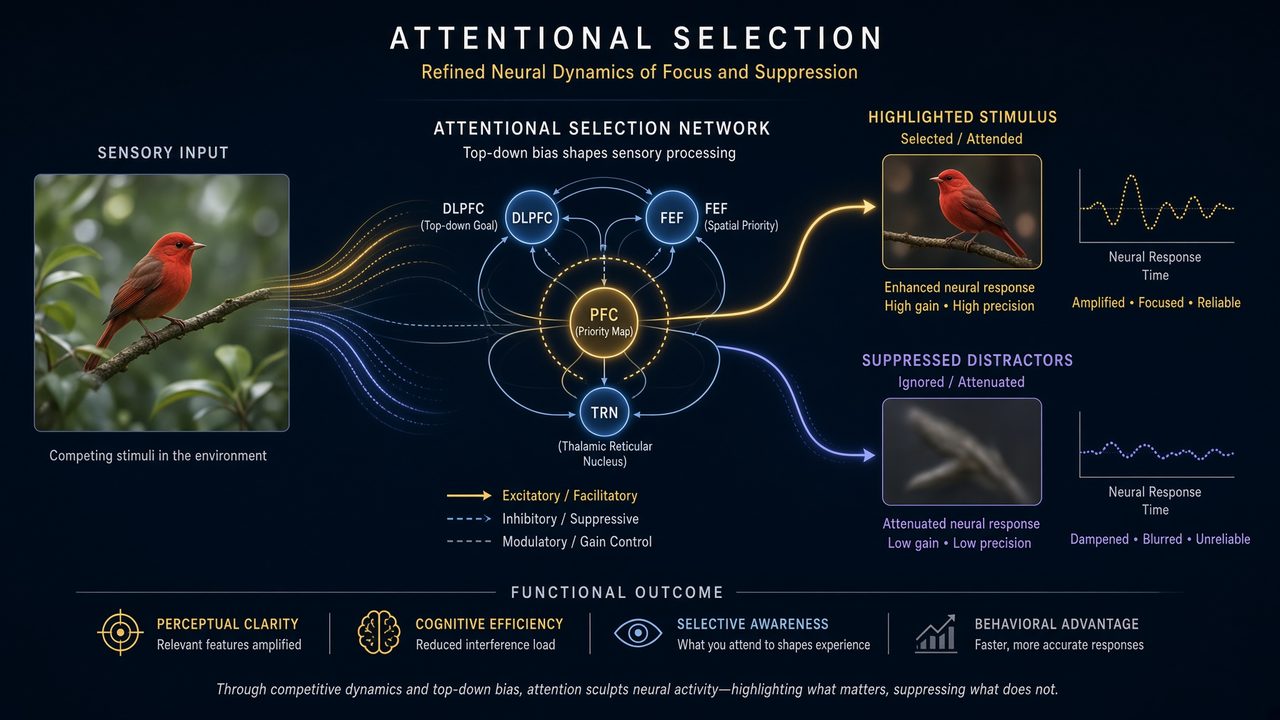
Attention
The dorsal attention network, including the intraparietal sulcus and frontal eye fields, directs attention voluntarily, while a ventral network, especially on the right, detects unexpected relevant stimuli.
Body schema
The brain maintains a model of body position and size, which allows you to move without looking.
Number and calculation
The intraparietal sulcus supports sense of magnitude and arithmetic.
Multisensory integration
It merges vision, touch and hearing, for example to coordinate hand movement with visual targets.
Language and reading
The angular gyrus helps with reading and linking written symbols to meaning.
Syndromes after damage
- Hemispatial neglect (often right parietal damage): ignoring the left side of space or one's own body. People may eat food from only half a plate, or draw only half a clock.
- Gerstmann syndrome (left angular gyrus): finger agnosia, left-right confusion, difficulty writing and calculating.
- Balint syndrome: difficulty perceiving more than one object, reaching under visual guidance and controlling eye gaze, after bilateral damage.
- Apraxia: difficulty performing learned movements.
- Astereognosis: inability to recognize objects by touch.
- Anosognosia: unawareness of deficits.
- Optic ataxia: inaccurate reaching under vision.
- Posterior cortical atrophy: a variant of Alzheimer's disease affecting visuospatial processing.
Everyday effects
Parietal problems may present as bumping into things, getting lost in familiar places, difficulty dressing, trouble reading a map or finding things on a cluttered desk.
Rehabilitation
Neglect therapy includes visual scanning training, prism adaptation and cues that draw attention to the neglected side. Occupational therapy adapts the environment and teaches compensation strategies.
Taking care of the parietal lobe
Prevent stroke by managing blood pressure, cholesterol and diabetes, avoid smoking, protect the head, and stay physically and mentally active. Seek medical attention for sudden confusion about space or body.
Why it matters in daily life
Parietal function is used constantly: judging whether a couch fits through a door, catching a ball, or reading a map. Video games and sports that demand spatial reasoning exercise these circuits, and some studies link spatial training to improved performance in science and mathematics. When spatial difficulty appears suddenly, it deserves prompt medical assessment, since stroke or tumor may be the cause.
Questions researchers are asking
Researchers are exploring how parietal maps of space are built from several senses, how the brain keeps a stable sense of body ownership, and whether training can improve spatial skills across ages. Brain-computer interfaces now use parietal signals to decode intended reaching, which may help people with paralysis control robotic arms.
Takeaway
The parietal lobe puts you in the world, turning sensory data into a map for action.
Further reading from authoritative sources
This article is educational and does not replace advice from a licensed clinician. See the medical disclaimer. Looking for specialist care? Browse the neurology clinic directory.