Digital Biomarkers for Brain Health
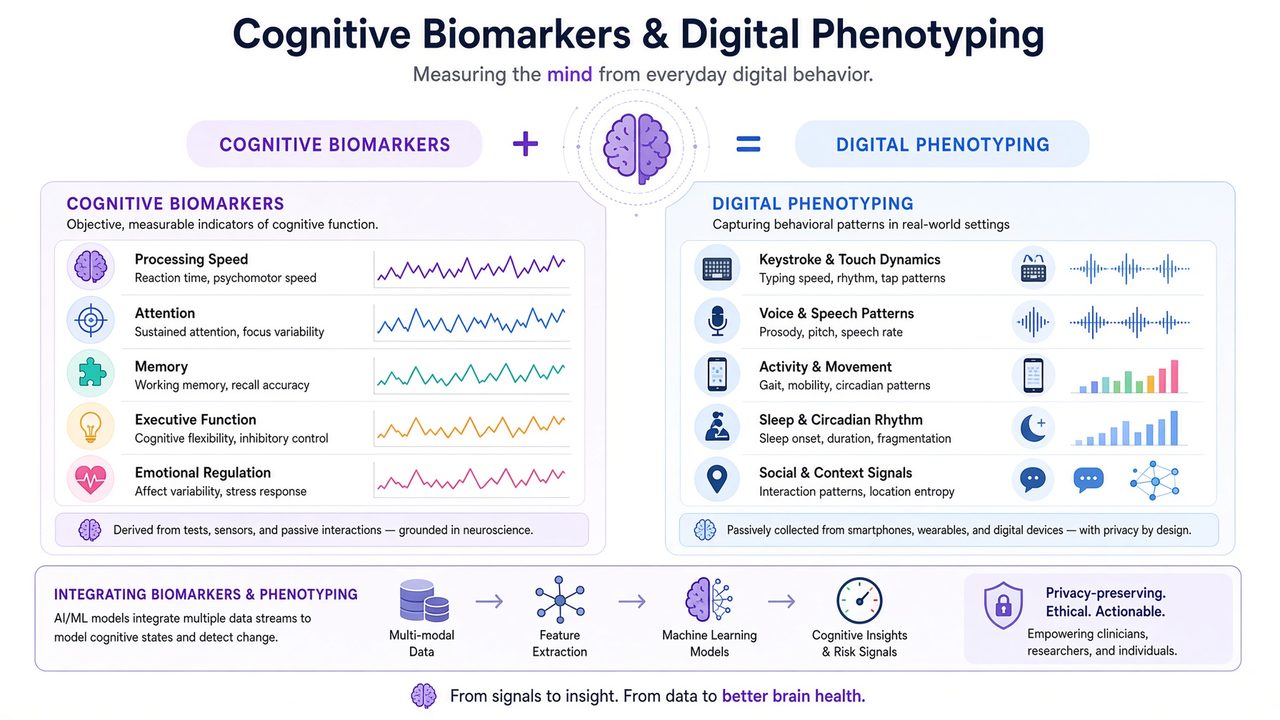
A biomarker is a measurable sign of a condition. Digital biomarkers use data from phones, wearables and sensors, collected passively in daily life, to signal changes in brain function. They offer continuous measurement, which may reveal change much earlier than occasional clinic visits.
What can be measured
- Gait and movement: accelerometers in phones and wearables can estimate walking speed, stride variability and tremor. In Parkinson's disease, smartphone tests and wearable sensors track tremor, bradykinesia and fluctuations. Slower gait predicts cognitive decline and falls in older adults.
- Speech and voice: automated analysis of pauses, word-finding, prosody and acoustic features can flag cognitive impairment, depression and Parkinson's.
- Typing and touchscreen behavior: keystroke dynamics and touch patterns can reveal motor slowing, and have been explored in Parkinson's, bipolar disorder and cognitive decline.
- Sleep and circadian rhythm: wearables track sleep timing, fragmentation and activity patterns, which relate to mood disorders and dementia risk.
- Activity and social behavior: step counts, location patterns and communication patterns may reflect depression or withdrawal.
- Eye movements and pupil responses: measured via cameras.
- Driving data: telematics reflect changes in older drivers.
- Smart home sensors: monitor routines and detect deviations.
- Digital cognitive tests: brief game-like tasks on tablets or phones to test memory and attention, repeated frequently.
Examples of progress
The Apple Parkinson's Disease study and the mPower study collected smartphone data from thousands of people. The Roche PD Mobile Application is used in trials. In multiple sclerosis, smartphone tests of dexterity and walking are used in trials. Researchers have shown that machine learning on speech data can distinguish early Alzheimer's disease with moderate accuracy. Regulators have begun to qualify digital endpoints, such as stride velocity 95th centile, as outcomes in Duchenne muscular dystrophy trials.

Challenges
- Validation: do the measures reflect the biology, and do they work across devices, ages and cultures?
- Variability and context: daily life is noisy.
- False alarms and anxiety.
- Privacy and consent: continuous monitoring is intrusive, and data could be misused.
- Equity: people without smartphones or with disabilities may be excluded.
- Data standards and interpretation.
- Clinical use: it is not yet clear how to act on subtle signals.
What you can do
Use consumer metrics, such as steps and sleep, as general feedback, but do not self-diagnose. Discuss meaningful changes in walking, memory or mood with a clinician. If you join a research study, ask how data are used and protected.
From signal to meaning
Raw sensor data must be turned into measures that clinicians trust. Researchers first show that a measure is reliable, meaning repeat tests give similar results, then that it is valid, meaning it tracks established clinical scales, and finally that it is sensitive to change over time. Regulators and groups such as the Digital Medicine Society publish frameworks to guide this verification and validation process.
Looking ahead
Combining several signals, such as sleep, speech and movement, is likely to be more informative than any single measure. Large, diverse datasets will be needed so that algorithms work equally well across ages, languages, skin tones and disabilities.
Takeaway
Digital biomarkers could make brain health monitoring continuous and personalized. Their value will depend on careful validation and respect for privacy.
Further reading from authoritative sources
- National Institute of Neurological Disorders and Stroke (NINDS)
- National Center for Complementary and Integrative Health (NCCIH)
This article is educational and does not replace advice from a licensed clinician. See the medical disclaimer. Looking for specialist care? Browse the neurology clinic directory.