Optogenetics: Controlling Neurons with Light
Imagine being able to switch a specific type of neuron on or off with a flash of light. Optogenetics made that possible, and has transformed neuroscience since its introduction in the early 2000s.
The basic idea
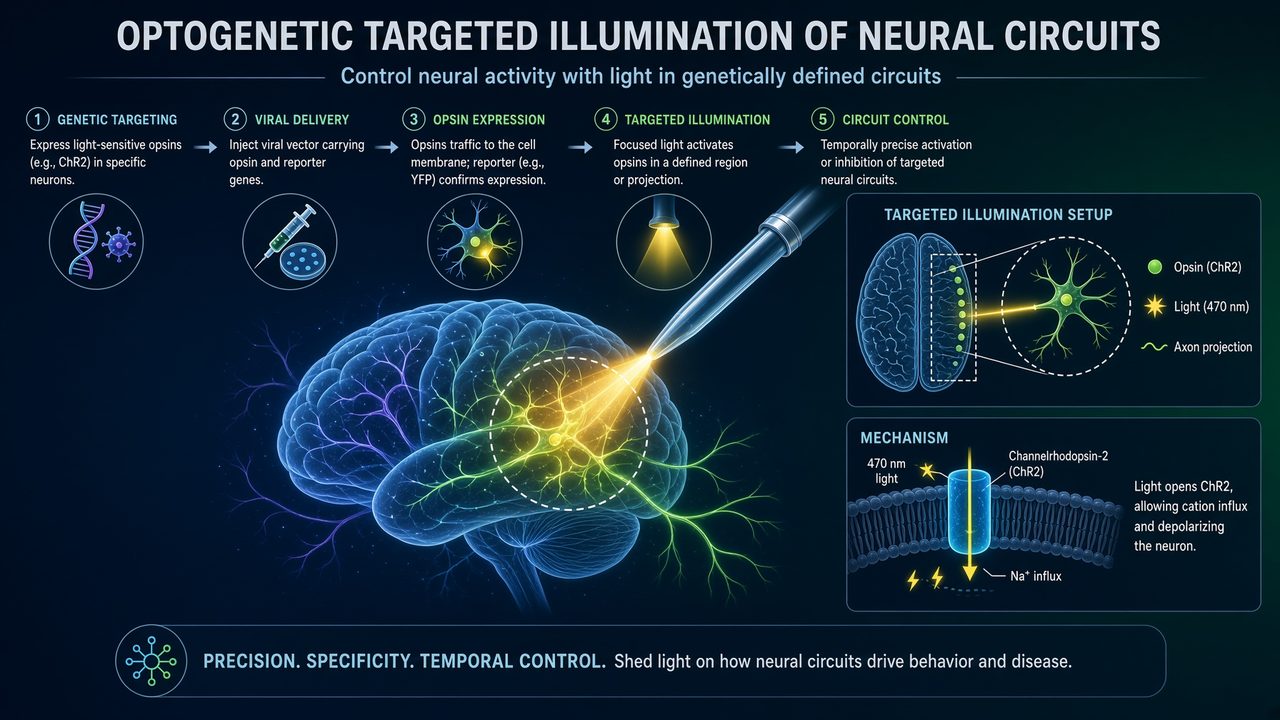
Many microbes make light-sensitive proteins called opsins. Channelrhodopsin, discovered in green algae, opens a channel when blue light hits it, allowing positive ions to flow into a cell, which excites a neuron. Halorhodopsin and archaerhodopsin respond to yellow or green light by inhibiting neurons. In 2005, Karl Deisseroth and Edward Boyden, with colleagues including Feng Zhang, showed that channelrhodopsin expressed in mammalian neurons could trigger action potentials with pulses of light. Georg Nagel, Peter Hegemann and others had discovered the channelrhodopsins.
How an experiment works
1. Delivery: a virus carrying the opsin gene is injected into a brain area, or transgenic animals are used, and the gene is expressed only in particular cell types using genetic promoters. 2. Light delivery: an optical fiber implanted in the brain, or fiber-free approaches, delivers light of the right wavelength. 3. Observation: researchers record behavior or neural activity while switching cells on and off.

What it has revealed
- Circuits for behavior: activating specific neurons in the amygdala can reduce or induce anxiety, and stimulating hypothalamic cells can trigger feeding or aggression.
- Memory: optogenetic reactivation of neurons that were active during learning can bring back a memory, and researchers have created false memories in mice. Work by Susumu Tonegawa and Steve Ramirez demonstrated this.
- Movement disorders and pain: circuits for Parkinson's symptoms, addiction and pain have been dissected.
- Sleep and arousal: identification of neurons that switch states.
- Seizures: light-based suppression of seizure activity in animal models.
- Technology development: more sensitive opsins, light-activated molecules, wireless implants and combined recording tools.
From mice to patients
Optogenetics requires gene delivery and light delivery, which makes human use challenging. The first success involves vision: in 2021, researchers reported that a blind man with retinitis pigmentosa regained limited ability to perceive objects after receiving an opsin gene therapy in the eye, combined with light-amplifying goggles, in a study led by José-Alain Sahel and Botond Roska. Other applications under study include hearing restoration and pain relief, while brain applications for epilepsy and Parkinson's disease remain preclinical.
Challenges
- Safe gene delivery, potential immune reactions and tissue damage from light
- Light penetration into deep tissue
- Long-term expression
- Ethics of altering human neurons
Why it matters beyond the lab
Because optogenetics identifies which cell types and connections drive a behavior, it helps researchers design drugs and stimulation targets with greater precision. Even if few treatments use it directly, the knowledge feeds therapies for epilepsy, depression, pain and movement disorders.
Limits to remember
Because results come largely from animals, findings must be confirmed in people, and brains differ between species in important ways.
Takeaway
Optogenetics gave neuroscientists a remote control for the brain. Its biggest impact is in basic science, and early medical uses are beginning.
Further reading from authoritative sources
- National Institute of Neurological Disorders and Stroke (NINDS)
- National Center for Complementary and Integrative Health (NCCIH)
This article is educational and does not replace advice from a licensed clinician. See the medical disclaimer. Looking for specialist care? Browse the neurology clinic directory.