Sleep Stages Explained: From Light Sleep to REM
Sleep may look like a single state, but the brain passes through distinct stages during the night, each with its own pattern of electrical activity and its own functions. Understanding them explains why total sleep time is not the only thing that matters.
How sleep is measured
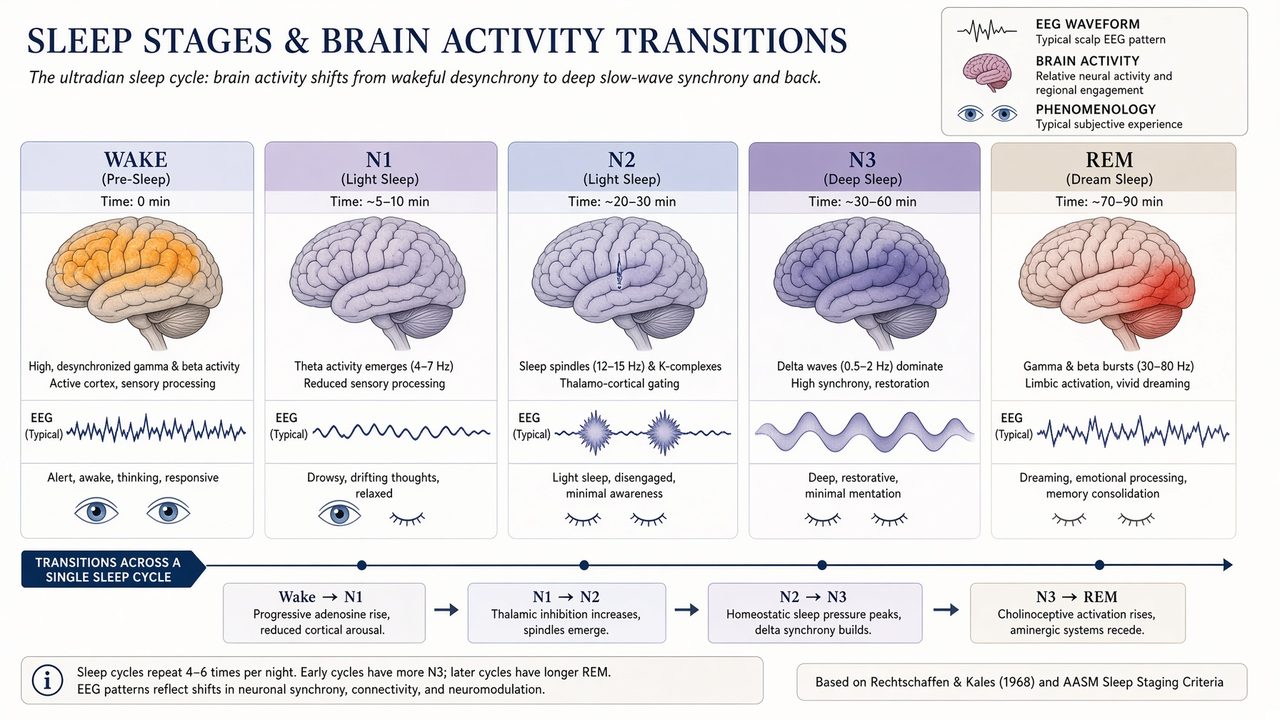
Sleep specialists classify sleep using polysomnography, which records brain waves by EEG, eye movements and muscle activity. Sleep is divided into non-REM sleep, which has three stages, and REM sleep, named for rapid eye movements.
Non-REM sleep
Stage N1: the doorway
This lightest stage lasts a few minutes. Brain waves slow from the alert rhythms of wakefulness, muscles relax, and you may experience a sudden twitch known as a hypnic jerk. You are easily awakened, and many people who wake from this stage say they were not asleep.
Stage N2: stable light sleep
Most of the night is spent in N2. Heart rate and body temperature fall. The EEG shows characteristic features called sleep spindles, short bursts of fast activity, and K-complexes, large slow waves. These are linked to memory processing and to protecting sleep from disruption by sounds.
Stage N3: deep or slow-wave sleep
In this stage, large, slow delta waves dominate. It is hardest to wake someone from N3, and people who are awakened often feel groggy and confused. Deep sleep is associated with physical restoration, growth hormone release, immune function and consolidation of factual memories. Sleepwalking and night terrors usually arise from this stage.

REM sleep
During REM, the brain becomes highly active, with EEG patterns resembling wakefulness. The eyes dart under closed lids, and most vivid dreaming occurs. Meanwhile, the brainstem causes most voluntary muscles to become temporarily paralyzed, which prevents you from acting out dreams. Breathing and heart rate become more variable. REM sleep is thought to contribute to emotional processing, memory integration and brain development in infants.
The sleep cycle
A full cycle lasts roughly 90 minutes in adults, though it varies. Over a typical night you pass through four to six cycles.
- Early in the night, cycles contain more deep N3 sleep.
- Later in the night, N3 shrinks and REM periods lengthen, with the longest REM episodes occurring in the early morning.
This is why people who sleep only five or six hours lose a disproportionate share of REM sleep, and why waking suddenly from a long REM period in the morning is common.
How sleep changes with age
Newborns spend about half their sleep in REM. Slow-wave sleep is abundant in childhood and declines steadily with age, while older adults tend to wake more often during the night. These changes are normal, though sleep disorders become more common with age and should not be dismissed as inevitable.
What disrupts sleep architecture
- Alcohol reduces REM sleep early in the night and fragments sleep later.
- Sleep apnea repeatedly interrupts sleep and prevents deep stages.
- Some medications, including certain antidepressants, can suppress REM.
- Irregular schedules and shift work disrupt the timing of stages.
- Noise, light and temperature can lighten sleep.
Do sleep trackers show your stages?
Wearable devices estimate stages using movement and heart rate. They can be useful for spotting trends, but they are not as accurate as laboratory measures, particularly for distinguishing specific stages. Treat their data as rough estimates and focus more on how you feel.
When to see a doctor
Persistent trouble falling asleep, loud snoring with pauses in breathing, acting out dreams, unusual movements, or excessive daytime sleepiness deserve evaluation. A sleep study can clarify what is happening and guide treatment.
Further reading from authoritative sources
- National Institute of Neurological Disorders and Stroke (NINDS)
- National Center for Complementary and Integrative Health (NCCIH)
This article is educational and does not replace advice from a licensed clinician. See the medical disclaimer. Looking for specialist care? Browse the neurology clinic directory.