The Neuroscience of Cooperation
Humans cooperate on a scale unmatched by other species, building cities, sharing knowledge and caring for strangers. Neuroscience and behavioral economics have identified brain systems that make cooperation possible, and that sometimes make it fail.
Reward for working together
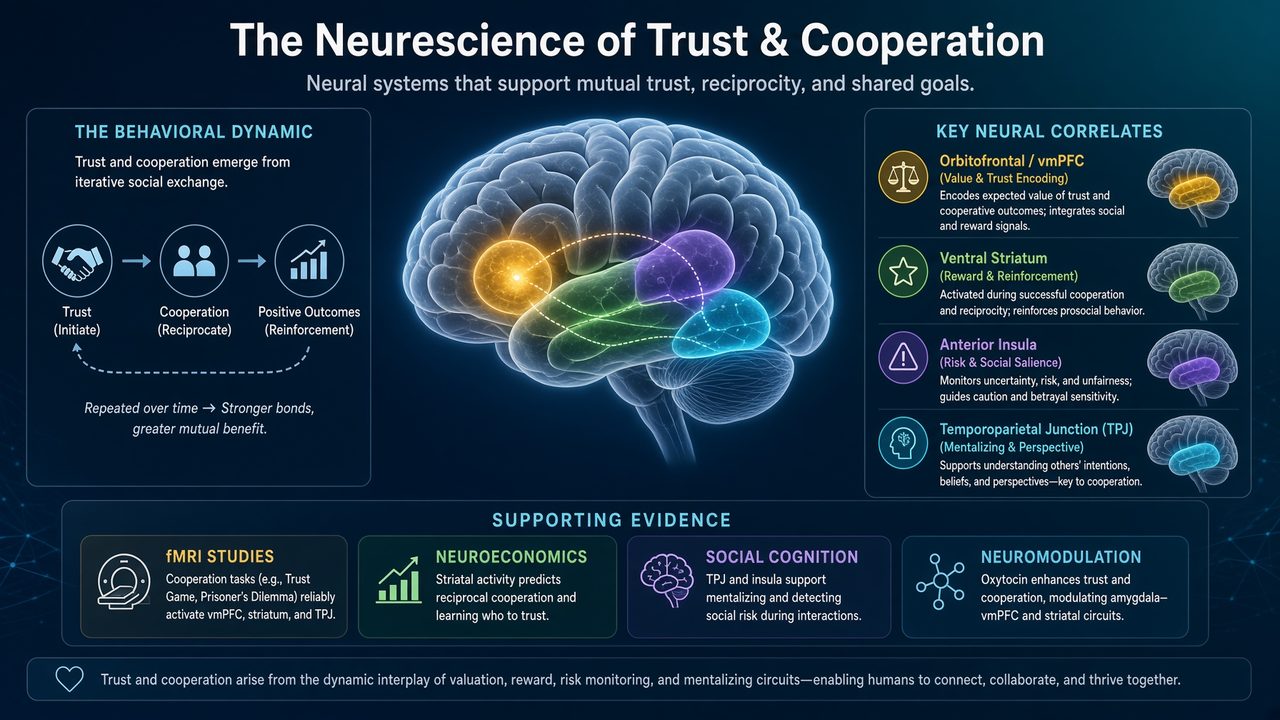
In a classic study by James Rilling and colleagues, women playing a repeated prisoner's dilemma showed activity in reward-related regions, including the nucleus accumbens, when partners cooperated, suggesting that mutual cooperation is intrinsically rewarding. Cooperating can feel good in itself, beyond the material payoff. Helping others also activates reward circuits, and in studies of charitable giving, donating money engages the same striatal areas as receiving it.
Empathy and perspective taking
Cooperation depends on understanding others' needs and intentions. Networks including the anterior insula, anterior cingulate, and temporoparietal junction support empathy and thinking about others' perspectives. Empathy for strangers can be reduced by competition or group boundaries, and expanded by contact and shared goals.

Self-control and norms
Sometimes selfish options are tempting. The prefrontal cortex helps override short-term self-interest to follow social norms. Ernst Fehr and colleagues found that people will pay to punish unfair partners, and that punishing norm violators activates reward regions, a form of costly enforcement that helps sustain cooperation. Studies also suggest that disruption of right lateral prefrontal activity can change how people respond to unfair offers, which indicates a role of control, though effects are small and interpretation is debated.
Trust, reputation and reciprocity
People cooperate more with those who have good reputations and with those expected to reciprocate. Repeated interactions foster cooperation because the future matters. Oxytocin has been linked to cooperation in some studies, but findings are mixed and context dependent, as discussed in other articles.
What undermines cooperation
- Anonymity and distance, which reduce accountability
- Perceived unfairness
- Competition and zero-sum framing
- Free riders who benefit without contributing
- Stress and threat, which narrow focus on self-protection
- Weak institutions and mistrust
Fostering cooperation
- Create shared goals that require interdependence
- Make contributions visible, and recognize them fairly
- Build trust through small commitments
- Set clear, fair rules and apply them consistently
- Encourage face-to-face or video contact, especially early in a project
- Promote psychological safety: Amy Edmondson's research shows that teams where people feel safe to speak up learn and perform better
- Reward group success alongside individual performance
- Model cooperation as leaders
- Use communication, since even brief conversation increases cooperation in experiments
Cooperation in daily life
Families, neighborhoods, workplaces and nations all depend on it. Practicing small acts, such as sharing resources, assisting neighbors and compromising in disagreements, makes cooperation a habit and strengthens the bonds that benefit health.
Cooperation across cultures and ages
Children as young as toddlers help others without being asked, and cooperation norms differ across societies. Large cross-cultural experiments by Joseph Henrich and colleagues show that market integration and community size shape fairness norms, so cooperation is part biology and part culture.
When cooperation fails
Breakdowns happen when people feel exploited. Repair requires acknowledging harm, restoring fairness and rebuilding trust through consistent behavior over time.
Takeaway
The brain is wired for cooperation, but it needs fairness, trust and shared purpose to flourish.
Further reading from authoritative sources
- National Institute of Mental Health (NIMH)
- National Institute of Neurological Disorders and Stroke (NINDS)
This article is educational and does not replace advice from a licensed clinician. See the medical disclaimer. Looking for specialist care? Browse the neurology clinic directory.