The Neuroscience of Social Learning
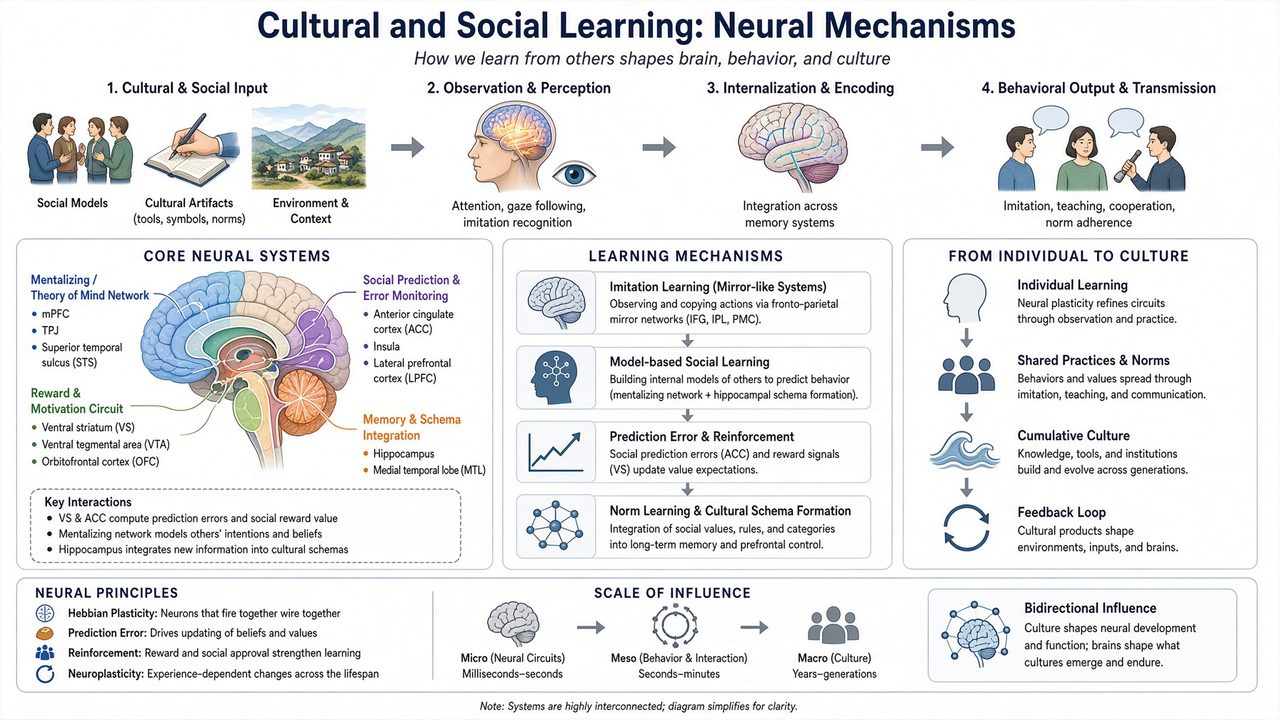
Much of what we know did not come from personal trial and error. We learn skills, language, norms and facts from other people. Social learning is a cornerstone of human culture, and the brain has special mechanisms for it.
Observational learning
Albert Bandura's Bobo doll experiments showed that children imitate aggressive behavior they have watched, demonstrating observational learning. Humans are especially skilled at imitation. Studies of toddlers show overimitation, in which children copy even unnecessary steps of an adult's demonstration, which supports transmission of tool use and customs.
Brain systems
- Mirror and action-observation networks: neurons in the premotor and parietal cortex of monkeys, first described by Giacomo Rizzolatti and colleagues, respond both when performing and observing actions. In humans, similar regions respond to observed actions, and are thought to support action understanding and learning of skills, although the exact role of mirror neurons in complex functions like empathy and language is debated.
- Reward learning: the striatum and dopamine system update predictions based on outcomes, including the outcomes others experience. People learn from others' rewards and punishments, as shown in studies of observational reinforcement learning by Christian Ruff, Tali Sharot and others.
- Mentalizing network: the medial prefrontal cortex and temporoparietal junction support inferring others' goals and beliefs, which helps to interpret what someone is teaching.
- Memory systems: the hippocampus and cortex store learned information.
Teaching and pedagogy
Humans actively teach, not only observe. Gergely Csibra and György Gergely proposed natural pedagogy, a human tendency to communicate knowledge using cues like eye contact and infant-directed speech, and infants are sensitive to such cues. Language greatly extends social learning.
Whom we learn from
People tend to copy those who are successful, prestigious, similar to themselves, or familiar. Conformity helps spread useful knowledge, but also errors and harmful norms. Online media magnify social learning, including misinformation.
Learning with others
Collaborative learning, peer tutoring and study groups can improve understanding, motivation and retention, especially when members explain ideas to each other. Teaching a concept to someone else is a powerful way to learn it, known as the protégé effect. Mentoring and apprenticeship use social learning to develop skills.
Tips for learning socially
- Watch skilled models, then practice with feedback
- Ask questions and discuss
- Explain what you learn to someone else
- Form study groups with diverse members
- Seek mentors and offer to mentor
- Be selective about role models and media
- Reflect on whether what you copy is useful
- Create a culture where mistakes are shared, so everyone learns
Social learning in childhood and adolescence
Infants follow gaze and pointing, toddlers copy actions, and adolescents learn norms from peers. Parents and teachers who model curiosity, kindness and persistence give children powerful lessons without lecturing.
Learning online
Videos, tutorials and communities give access to expert models. Pair watching with doing, because the brain consolidates skills best through active practice, feedback and sleep.
Takeaway
We are social learners. Choose your models and learning partners wisely, and share your knowledge.
Further reading from authoritative sources
- National Institute of Mental Health (NIMH)
- National Institute of Neurological Disorders and Stroke (NINDS)
This article is educational and does not replace advice from a licensed clinician. See the medical disclaimer. Looking for specialist care? Browse the neurology clinic directory.