The Neuroscience of Imagination
Imagination is the ability to form mental images, scenarios and ideas that are not present to the senses. It underlies planning, creativity, empathy, fiction and play, and it relies on many of the same brain systems that we use for perception and memory.
Constructive memory and scene building
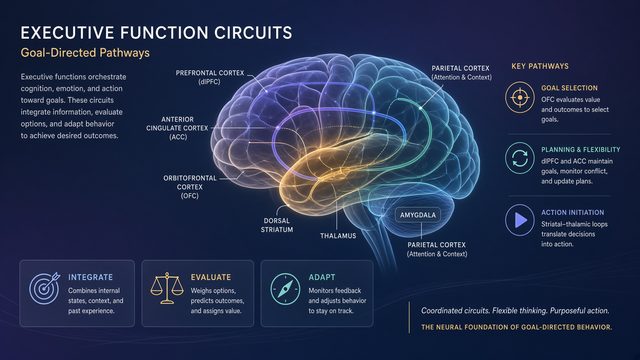
Studies by Demis Hassabis, Eleanor Maguire and others in 2007 showed that patients with hippocampal damage had difficulty imagining new, detailed scenes, even though they could describe objects. Healthy people imagining fictitious scenes activate the hippocampus, the parahippocampal gyrus, and the retrosplenial cortex. Daniel Schacter and Donna Addis proposed the constructive episodic simulation hypothesis, that memory is a flexible system that recombines elements of past experience to imagine future events. The same core network, which overlaps with the default mode network, supports remembering the past, imagining the future, daydreaming and thinking about other people's minds.
Mental imagery
Visualizing an object activates parts of visual cortex that respond when we see it, and imagining sounds or movements activates auditory and motor regions, though activity is weaker. Stephen Kosslyn's work showed that mental images preserve spatial properties. Top-down signals from frontal and parietal regions generate the image. Individual differences in imagery vividness are large. Adam Zeman and colleagues described aphantasia, in which people cannot voluntarily form mental images, estimated to affect about 1 to 4 percent of people, and hyperphantasia, with extremely vivid imagery. People with aphantasia can still think, remember facts and often lead successful lives, but may have less vivid autobiographical memory and imagination of scenes, and many use other strategies.

Imagination and emotion
Imagined events can evoke real emotions and physiological responses. This is why visualization is used in therapies, such as imaginal exposure for anxiety and trauma, and in sport psychology. Imagination also supports empathy and moral reasoning by letting us simulate others' experiences.
Development and play
Children begin pretend play around age two, and develop imaginary companions and elaborate narratives. Pretend play supports language, social understanding and self-regulation. Imagination is shaped by culture, stories and education.
Disorders
Altered imagination appears in conditions such as depression, in which future imagining can be less specific and positive, in anxiety, with catastrophic scenarios, and in post-traumatic stress disorder, with intrusive imagery. Hallucinations differ from imagination because the person does not recognize the experience as self-generated.
Strengthening imagination
- Read fiction and listen to stories
- Daydream and let your mind wander
- Practice visualization: picture a familiar place in detail, or rehearse an upcoming event
- Engage in pretend play with children, and role play as an adult
- Draw, write and make music
- Use mental rehearsal for skills or performance
- Travel and try new experiences, which provide raw material
- Practice mindfulness, which can reduce unhelpful rumination and free imagination
Imagination and wellbeing
Imagining pleasant scenes can reduce stress, and guided imagery is used in pain management, relaxation and preparation for medical procedures. Imagining acts of kindness toward others can increase feelings of connection. Keeping imagination balanced with action turns ideas into real change.
Takeaway
Imagination is the brain's simulator. Feed it with experience and give it room to play.
Further reading from authoritative sources
- National Institute of Neurological Disorders and Stroke (NINDS)
- National Institute of Mental Health (NIMH)
This article is educational and does not replace advice from a licensed clinician. See the medical disclaimer. Looking for specialist care? Browse the neurology clinic directory.