The Neuroscience of Morality
Morality, our sense of right and wrong, guides behavior and shapes societies. Neuroscience and psychology explore how moral intuitions arise, how they are processed, and why people disagree.
Emotion and reason
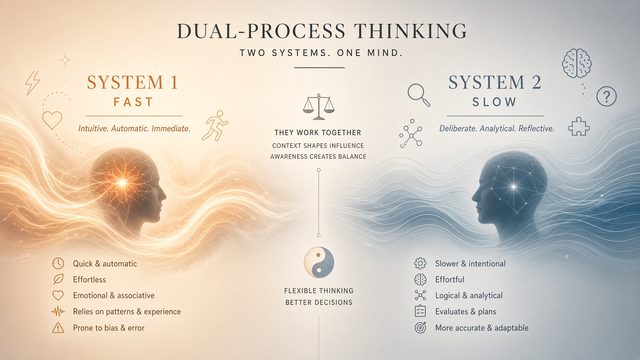
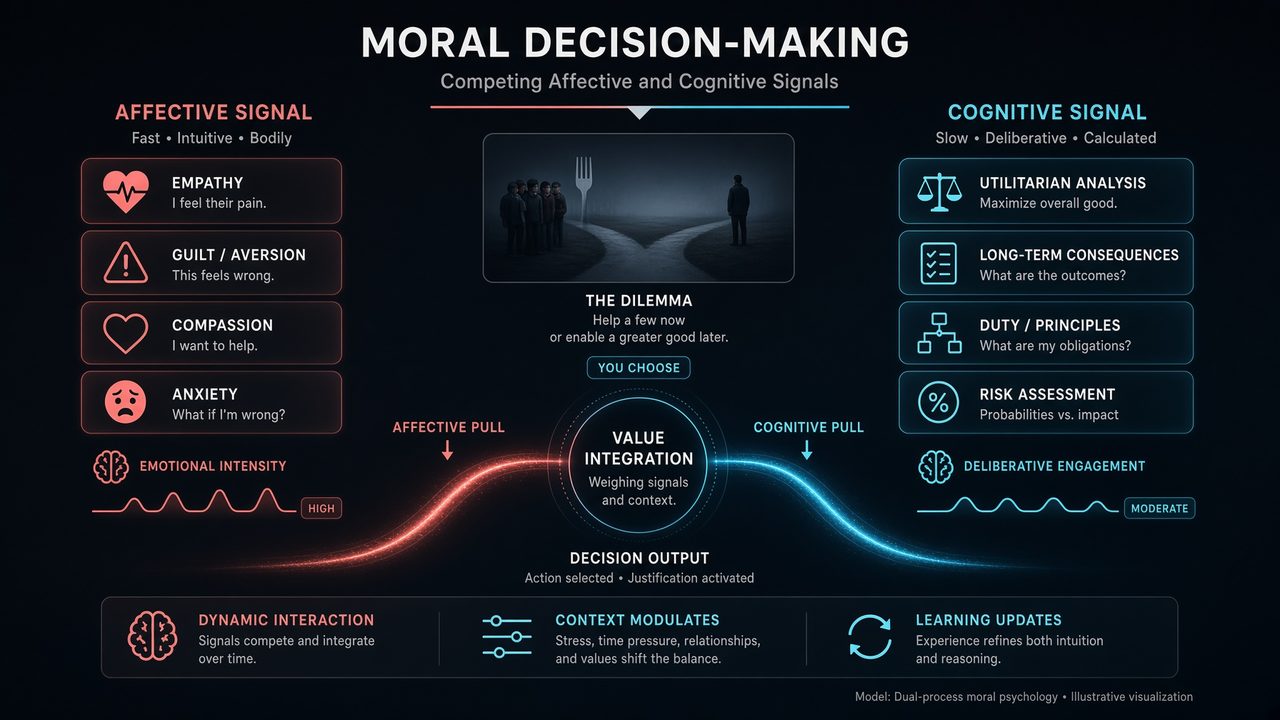
Joshua Greene and colleagues used brain imaging with moral dilemmas such as the trolley problem. Most people would divert a runaway trolley to save five people at the cost of one, but fewer would push a person off a footbridge to do the same. Personal, harm-related dilemmas engaged emotion-related regions, including the medial prefrontal cortex and amygdala, while impersonal dilemmas engaged regions linked to deliberate reasoning, such as the dorsolateral prefrontal cortex. Greene proposed a dual-process theory, in which fast emotional responses favor rules against harm, and slower reasoning favors weighing outcomes. Critics argue that the distinction is too simple, since both systems interact, and emotions are involved in all moral reasoning.
Brain regions
- Ventromedial prefrontal cortex: integrates emotion into valuation. Patients with damage here, studied by Antonio Damasio and Michael Koenigs, more often endorse utilitarian choices in personal dilemmas, and may make poor social decisions.
- Temporoparietal junction: thinking about others' beliefs and intentions. Rebecca Saxe and colleagues showed that disrupting it with magnetic stimulation reduced the weight placed on intent in moral judgment.
- Amygdala and insula: emotional responses, including disgust and empathy
- Anterior cingulate: conflict
- Reward regions: the pleasure of fairness and cooperation
Moral foundations
Jonathan Haidt proposed that moral intuitions are organized into foundations such as care, fairness, loyalty, authority, sanctity and liberty, weighted differently by different cultures and political outlooks. His social intuitionist model argues that people often make quick intuitive judgments and then justify them with reasoning afterwards, though he and others acknowledge that reasoning can change minds, especially in conversation.
Development
Infants as young as a few months prefer helpers to hinderers in puppet shows, according to studies by Paul Bloom, Karen Wynn and Kiley Hamlin, suggesting early social evaluation. Morality develops through empathy, culture, parenting and experience. Lawrence Kohlberg described stages of moral reasoning, later criticized for cultural and gender bias by Carol Gilligan and others.
Individual differences and conditions
Psychopathy involves reduced empathy and emotional responsiveness, with atypical functioning of the amygdala and ventromedial prefrontal cortex, as studied by James Blair, but most people with psychopathic traits can still understand moral rules. Stress, intoxication, fatigue and group influence can alter moral behavior. Oxytocin and other hormones modulate trust and parochial altruism.
What neuroscience can and cannot say
Brain research describes how people make moral judgments, which can inform law, education and policy. It cannot by itself say what is right. Moving from is to ought requires ethical argument. Findings should not be used to excuse or condemn individuals based on scans.
Cultivating moral growth
- Practice perspective taking
- Reflect on values and consequences
- Discuss dilemmas with people who disagree
- Notice biases and emotion, and slow down for big decisions
- Build habits of kindness and honesty
- Support fair institutions
Takeaway
Moral life is a collaboration of feeling and thought. Understanding it can help us reason better, with humility.
Further reading from authoritative sources
- National Institute of Neurological Disorders and Stroke (NINDS)
- National Institute of Mental Health (NIMH)
This article is educational and does not replace advice from a licensed clinician. See the medical disclaimer. Looking for specialist care? Browse the neurology clinic directory.