How Stress Hormones Affect Memory Formation
Anyone who has blanked during an exam or vividly remembered a frightening event has seen how stress shapes memory. The effects are not simply good or bad. They depend on which hormones are released, when, how much, and which memory stage is involved.
The stress response in brief
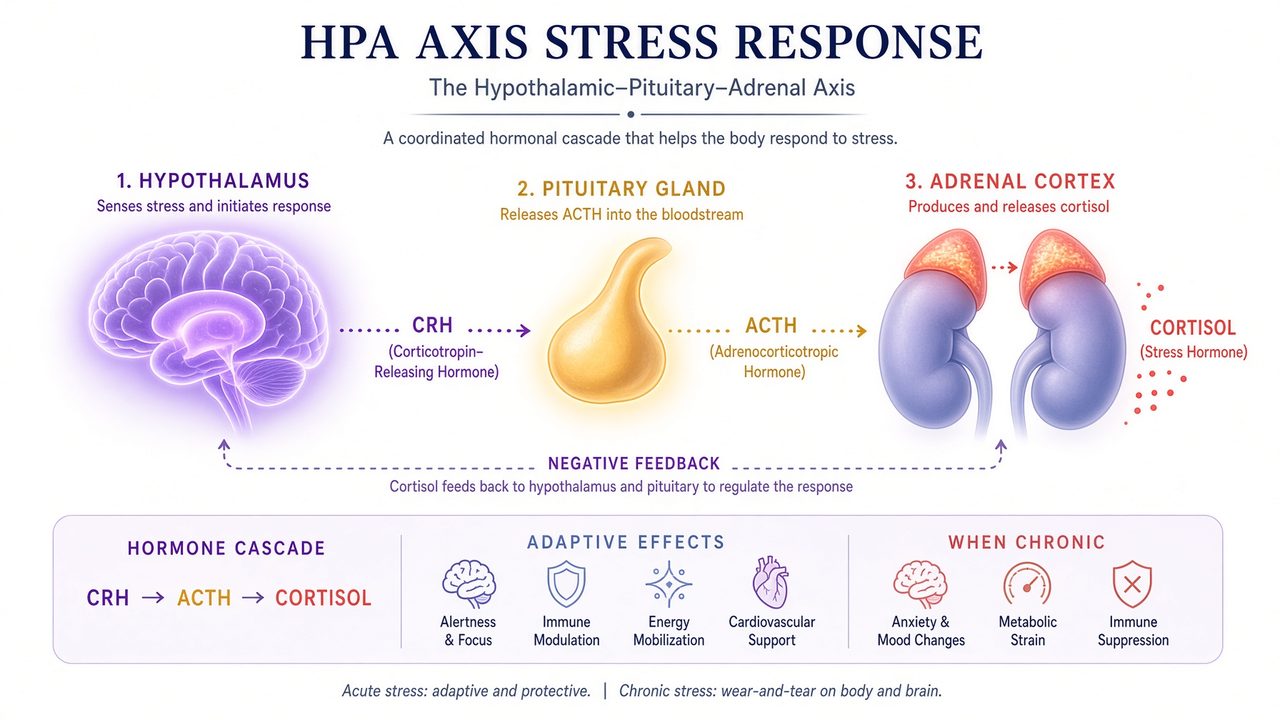
When the brain perceives a threat, two systems activate. The sympathetic-adrenal system releases adrenaline and noradrenaline within seconds. The hypothalamic-pituitary-adrenal (HPA) axis follows more slowly, releasing cortisol, which peaks around 20 to 30 minutes after the stressor and then declines. Both hormone families reach the brain, where the hippocampus, amygdala and prefrontal cortex carry receptors for them.
Stress can strengthen memory formation
Emotionally arousing events are remembered better than neutral ones. James McGaugh and colleagues showed that adrenaline released during arousal activates noradrenaline signals in the basolateral amygdala, which then modulates consolidation in the hippocampus and other regions. Cortisol acting around the time of learning, and shortly after, enhances consolidation of emotional information. This arrangement likely evolved because remembering dangerous or rewarding situations improves survival. It helps explain why people recall where they were during a shocking event.

Stress can impair retrieval and working memory
The same hormones have the opposite effect at other points:
- Retrieval: high cortisol levels at the time of recall impair retrieving previously learned material, particularly emotionally neutral information. This is the "blank on the exam" effect.
- Working memory: the prefrontal cortex is very sensitive to catecholamines. Moderate levels help, but high levels of noradrenaline and dopamine disrupt prefrontal networks, impairing planning and holding information in mind. Amy Arnsten described this as a shift from thoughtful prefrontal control to reflexive amygdala and striatal control.
- Flexible learning: under stress, people rely more on habit-like learning and less on flexible, hippocampus-dependent learning.
An inverted U
The relationship between arousal and performance often follows an inverted U. Too little arousal leads to poor engagement, moderate arousal optimizes performance, and too much impairs it. Individual differences in baseline stress reactivity, sex, age and prior experience shift where the peak occurs.
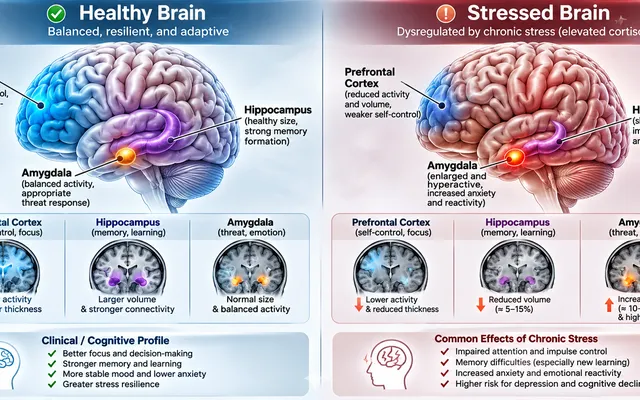
Chronic stress and the hippocampus
Prolonged elevation of cortisol is associated with:
- Dendritic shrinkage in hippocampal neurons and loss of spines in animal studies
- Reduced neurogenesis in the dentate gyrus in rodents
- Smaller hippocampal volume in people with long-term depression, PTSD or Cushing's syndrome, and in some studies of those exposed to early adversity
- Enlarged amygdala dendrites, enhancing fear responses
- Weakened prefrontal regulation
Many of these changes are at least partly reversible when stress is relieved, which is encouraging. Exercise, sleep and effective treatment of depression or anxiety can restore function in animals and, to some extent, in people.
Timing, sex and age
Stress before learning can sometimes enhance emotional memory but impair neutral memory. Women and men show different patterns in some studies, partly related to hormones such as estrogen and to differing coping strategies. Older adults and children may be more vulnerable to disrupted memory under stress, and early life stress shapes later HPA reactivity.
Practical ways to protect memory
- Prepare ahead of high-stakes events, so that retrieval relies on well-practiced material, which is more resilient under stress.
- Practice under realistic conditions, a principle used in training of pilots and surgeons.
- Use brief relaxation techniques such as slow breathing before tests to lower arousal.
- Sleep adequately, as sleep loss amplifies stress reactivity and impairs consolidation.
- Exercise regularly, which helps regulate the stress response and supports the hippocampus.
- Reframe arousal as helpful energy, which in some studies improves performance.
- Seek help for chronic stress, anxiety, depression or trauma, since long-term stress is harmful for both mood and memory.
Takeaway
Stress hormones are tools that can sharpen or scramble memory. Keeping stress in a manageable range, and recovering well, protects the learning machinery of the brain.
Further reading from authoritative sources
- National Institute of Neurological Disorders and Stroke (NINDS)
- National Center for Complementary and Integrative Health (NCCIH)
This article is educational and does not replace advice from a licensed clinician. See the medical disclaimer. Looking for specialist care? Browse the neurology clinic directory.