The Neuroscience of Expertise: How Practice Shapes the Brain
What distinguishes a chess master, a concert violinist or a veteran surgeon? Talent matters, but neuroscience shows that long, focused practice produces measurable changes in brain structure and function, and a distinctive way of seeing problems.
Structural changes
- London taxi drivers: Eleanor Maguire found that drivers who had memorized the city's streets, known as "The Knowledge," had larger posterior hippocampi than controls, and the volume correlated with years of experience. Trainees who passed the test showed increases in hippocampal gray matter, while those who failed did not.
- Musicians: violinists and pianists have enlarged sensorimotor representations of the fingers they use, and professional musicians show larger auditory cortex regions and stronger corpus callosum connectivity, especially if training started early.
- Jugglers: Bogdan Draganski showed that learning to juggle led to temporary gray matter increases in motion-processing areas, which diminished when practice stopped.
- Athletes and others: differences in motor and visual regions are reported, and expert badminton or golf players show more efficient activation.
Cross-sectional studies cannot fully separate training effects from pre-existing differences, but longitudinal designs support a role for experience.
Functional efficiency
Experts often show less brain activity for a task than novices, a pattern called neural efficiency, because skills are automated and require fewer resources. At the same time, they may recruit specialized regions more precisely, for example, expert radiologists show greater engagement of the fusiform region when viewing X-rays, similar to face experts.

Chunking and pattern recognition
Classic studies by Herbert Simon and William Chase found that chess masters recall real game positions far better than novices, but not random arrangements. They have stored tens of thousands of meaningful patterns, or chunks, which let them perceive the board holistically and select moves quickly. Expert memory in medicine, firefighting and sports works similarly, with experts recognizing situations based on cues that novices miss and mentally simulating outcomes.
Long-term working memory
Anders Ericsson and Walter Kintsch proposed that experts use long-term memory structures as an extension of working memory, retrieving information through cues. This explains how people can hold more information in an area of expertise than their limited working memory would suggest.
The role of practice
The "10,000-hour rule" popularized by Malcolm Gladwell oversimplifies Ericsson's findings. Practice quantity matters, but its quality matters more: deliberate practice, focused on specific weaknesses with feedback, produces the greatest gains. Meta-analyses suggest that practice explains a substantial but incomplete share of performance differences, around a third in music and games, and less in some professions, and genetics, starting age, instruction and opportunity also contribute.
Plasticity at different ages
Early training can produce especially strong changes, such as absolute pitch being associated with early musical training, but adults can build expertise too, albeit more slowly in some domains.
Downsides
Expertise can bring rigidity. Experts may be overconfident, rely on habits, and struggle when conditions change. The expertise reversal effect shows that instructional methods helpful to novices may impair experts.
Lessons for learners
- Practice deliberately: set specific goals, work at the edge of ability, and get feedback.
- Build a base of patterns by studying many examples, including worked solutions.
- Space and interleave practice.
- Rest and sleep: consolidation happens offline.
- Seek coaching or mentors who can identify gaps.
- Stay curious and keep testing yourself in new situations.
- Be patient: the biological changes accumulate over months and years.
Takeaway
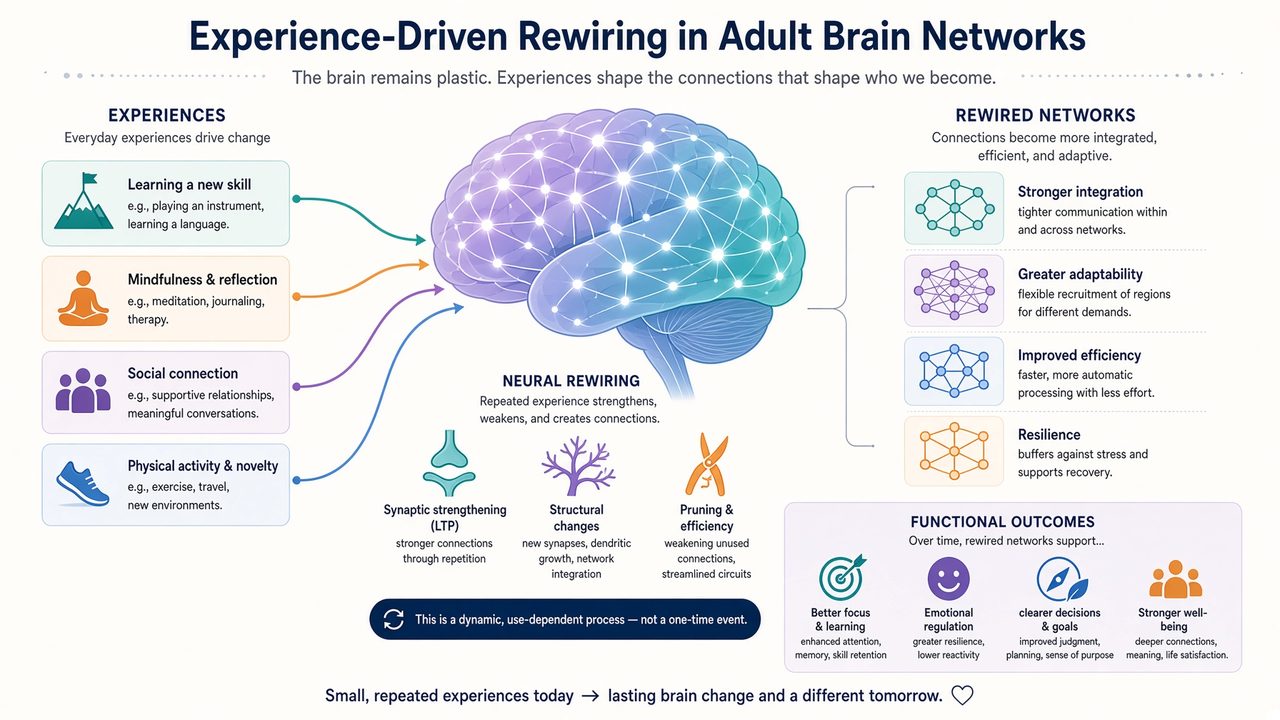
Expertise is a story of brain adaptation. The same plasticity that built the experts' skills is available to any committed learner.
Further reading from authoritative sources
- National Institute of Neurological Disorders and Stroke (NINDS)
- National Center for Complementary and Integrative Health (NCCIH)
This article is educational and does not replace advice from a licensed clinician. See the medical disclaimer. Looking for specialist care? Browse the neurology clinic directory.