The Role of Sleep Spindles in Learning
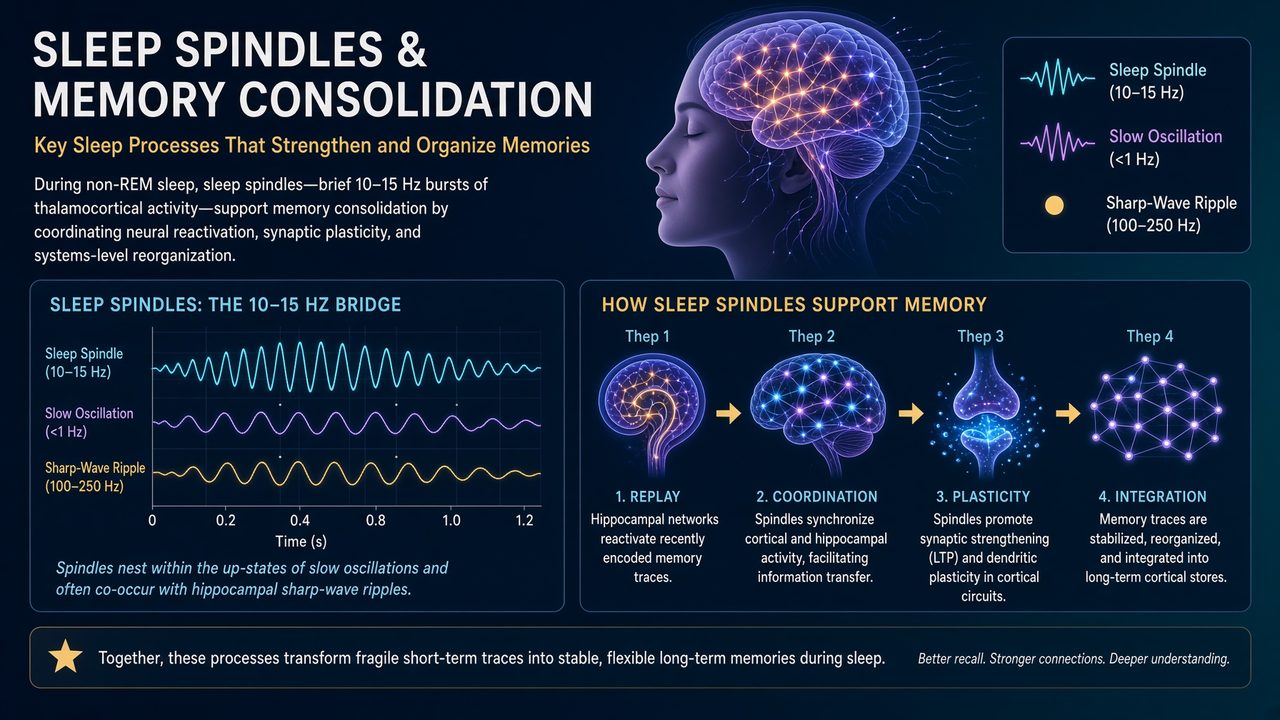
During light non-REM sleep, the electroencephalogram shows brief bursts of rhythmic activity, about 11 to 16 Hz, that look like spindles of thread. These sleep spindles are among the brain's most important tools for consolidating what we learned during the day.
What spindles are
Spindles last about half a second to two seconds and occur mainly in stage 2 sleep. They are generated by interactions between the thalamic reticular nucleus and thalamocortical neurons, and then propagate through cortex. Two types are described: slow spindles (about 9 to 12 Hz, frontal) and fast spindles (12 to 15 Hz, centroparietal). During spindles, the thalamus partly blocks external sensory input, which helps maintain sleep.
The dialogue between hippocampus and cortex
According to the active systems consolidation model, during slow-wave sleep the hippocampus replays recently encoded memories. Three rhythms synchronize:
- Slow oscillations (about 1 Hz) in the cortex provide a timing frame.
- Spindles nested in the up-states of slow oscillations open windows for plasticity in the cortex.
- Hippocampal sharp-wave ripples carry replayed information.
When these events are coupled, memory traces are gradually integrated into cortical networks, making them less dependent on the hippocampus.

Evidence from human studies
- Spindle density and memory: people with more spindles after learning word pairs tend to show better overnight retention. Studies by Robert Stickgold, Matthew Walker and others found increases in spindle density after learning and correlations with improvement.
- Motor learning: overnight improvements in finger-tapping tasks correlate with stage 2 spindles over motor areas.
- Intelligence and learning ability: spindle characteristics correlate with scores on reasoning tests, perhaps reflecting efficient thalamocortical communication.
- Experimental enhancement: studies using auditory stimulation timed to slow oscillations, or using the drug zolpidem, which increases spindles, reported improved memory in some experiments, though effects are variable and not clearly beneficial in all cases.
- Targeted memory reactivation: playing a sound or scent that was associated with learning during sleep can enhance memory for that material.
Spindles in disease
- Schizophrenia: reduced spindle density has been observed, including in early stages and in relatives, and is related to cognitive deficits and positive symptoms. It is being studied as a biomarker and treatment target.
- Autism and developmental disorders: altered spindle activity is reported.
- Alzheimer's and aging: spindle density and amplitude decline with age and are reduced in mild cognitive impairment and dementia.
- ADHD and sleep disorders: differences have been reported.
- Epilepsy: some seizure types involve altered thalamocortical oscillations resembling spindles.
Factors that affect spindles
Age, medications (benzodiazepines can increase spindles), sleep deprivation, alcohol, timing of sleep, and some drugs influence spindle activity. Naps containing stage 2 sleep also produce spindles that support learning.
Protecting sleep for learning
- Aim for seven to nine hours for most adults, and more for teenagers and children.
- Keep a regular sleep schedule.
- Study before sleep, and avoid all-nighters, since cutting sleep short reduces the later part of the night rich in stage 2 sleep and spindles.
- Limit alcohol and sedatives, which can distort sleep architecture.
- Treat sleep apnea, insomnia and other disorders.
- Create a restful sleep environment.
- Nap strategically: a 60 to 90 minute nap can include slow-wave and stage 2 sleep.
- Be wary of consumer products claiming to boost spindles without strong evidence.
Takeaway
Sleep spindles are tiny bursts with large consequences for learning. Protecting your sleep protects your memory.
Further reading from authoritative sources
- National Institute of Neurological Disorders and Stroke (NINDS)
- National Center for Complementary and Integrative Health (NCCIH)
This article is educational and does not replace advice from a licensed clinician. See the medical disclaimer. Looking for specialist care? Browse the neurology clinic directory.