Compassion and the Brain: The Neuroscience of Kindness
Compassion is the feeling of concern for another's suffering combined with a motivation to help. Neuroscience has begun to map how it works in the brain, how it differs from simply feeling what others feel, and whether it can be strengthened with practice.
Empathy versus compassion
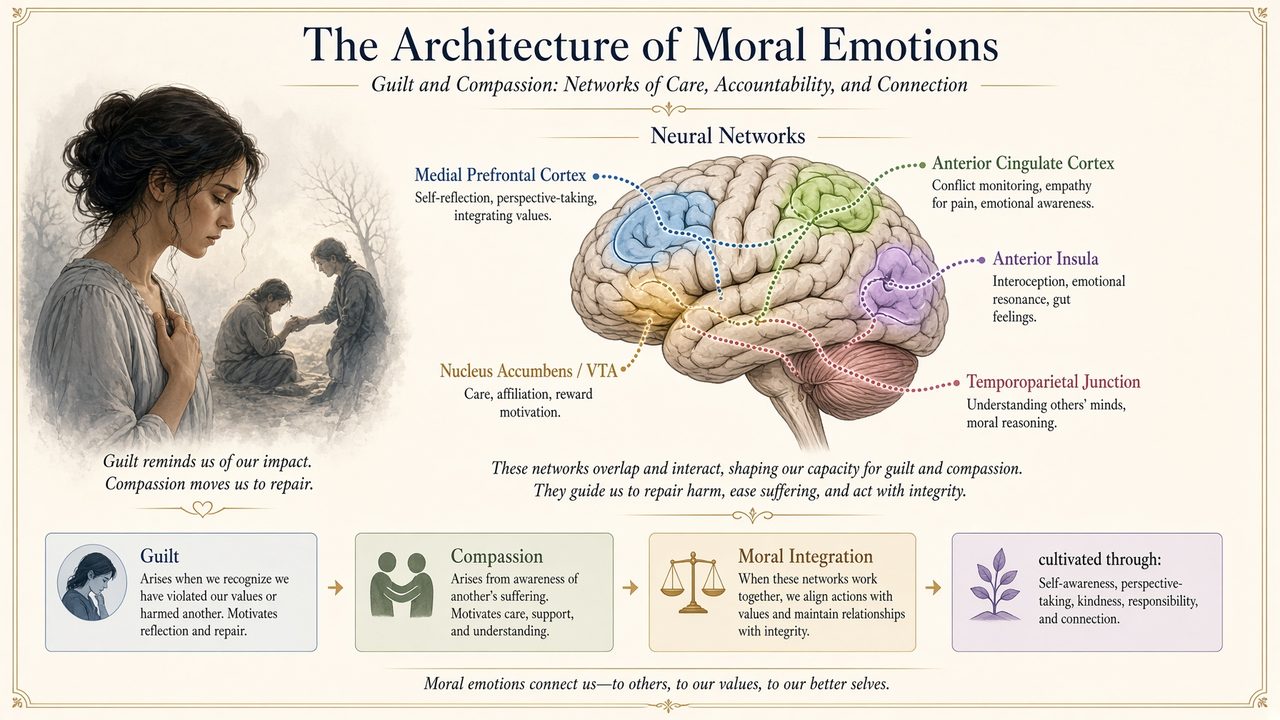
Tania Singer and Olga Klimecki distinguish between empathy, which is sharing another's feelings, and compassion, which is warm concern and a wish to help. When people empathize with someone in pain, regions such as the anterior insula and anterior cingulate cortex, which are also active when experiencing pain themselves, become active. Prolonged empathic distress can lead to withdrawal and burnout. Compassion, in contrast, engages regions linked with positive affect, affiliation and reward, including the medial orbitofrontal cortex, ventral striatum and parts of the midbrain.
Brain systems involved
- Insula and anterior cingulate: detect and represent the other person's distress.
- Medial prefrontal cortex and temporoparietal junction: take the other's perspective.
- Ventral striatum and orbitofrontal cortex: reward and motivation to care.
- Oxytocin and opioid systems: support bonding and caregiving. Studies suggest oxytocin can increase prosocial behavior in some contexts, though effects vary.
- Vagal tone: higher heart rate variability is associated with greater compassion and social connectedness.

Can compassion be trained?
Studies of compassion meditation, including loving-kindness practice, suggest that it can. In experiments led by Richard Davidson and Antoine Lutz, long-term meditators showed increased activity in empathy-related regions when practicing compassion. In training studies, participants who completed brief compassion courses showed changes in activity in the inferior parietal cortex, dorsolateral prefrontal cortex and medial orbitofrontal cortex, and were more likely to behave generously in an economic game. Singer's group found that empathy training increased negative affect, while compassion training increased positive affect and prosocial behavior, suggesting that the two training types lead to different outcomes.
Benefits of compassion
- Well-being: acts of kindness are associated with higher positive mood.
- Health: some studies link compassion practice with reduced inflammation markers and improved vagal tone, though evidence is preliminary.
- Relationships: compassion fosters trust and cooperation.
- Resilience for caregivers: training may reduce burnout in health professionals.
- Self-compassion: treating yourself kindly in difficulty is associated with lower anxiety and depression.
Limits and cautions
Compassion can be reduced by fatigue, overload, in-group biases and distance, as with the "compassion fade" phenomenon, where concern falls as the number of victims grows. Effects of short interventions may be modest, and some studies have small samples. Compassion is not the same as self-sacrifice without boundaries.
Practices to try
- Loving-kindness meditation: silently wish well-being first for yourself, then a loved one, a neutral person, a difficult person and all beings.
- Compassionate action: small acts of kindness, such as checking in on a friend.
- Perspective-taking: imagine the life and pressures of someone you find difficult.
- Slow breathing, which builds the calm needed to care without being overwhelmed.
- Volunteering or helping in community settings.
- Self-compassion breaks: acknowledge pain, remember that suffering is shared, and speak kindly to yourself.
Takeaway
Compassion is a trainable skill with its own brain signature. Cultivating it benefits both the person who receives kindness and the one who gives it.
Further reading from authoritative sources
- National Institute of Mental Health (NIMH)
- National Center for Complementary and Integrative Health (NCCIH)
This article is educational and does not replace advice from a licensed clinician. See the medical disclaimer. Looking for specialist care? Browse the neurology clinic directory.