How the Brain Regulates Fear
Fear is essential for survival, but an alarm that cannot be turned off causes suffering. The brain has sophisticated mechanisms for detecting danger and for dialing fear back once the threat has passed, and understanding them helps explain anxiety disorders and treatments.
The fast route and the slow route
Joseph LeDoux described two routes for threat information. A fast, rough "low road" sends sensory input from the thalamus directly to the amygdala, triggering protective reactions before we are consciously aware. A slower "high road" passes through the cortex for detailed analysis. This explains why we jump at a stick that looks like a snake before realizing that it is not.
Core fear circuitry
- Amygdala: the lateral nucleus receives sensory input, and the central nucleus triggers responses through the hypothalamus (stress hormones), brainstem (heart rate, freezing) and periaqueductal gray (defensive behaviors). Distinct subregions can promote or reduce fear.
- Bed nucleus of the stria terminalis (BNST): involved in sustained, anticipatory anxiety about uncertain threats, as opposed to phasic fear of immediate threats.
- Hippocampus: provides context, so that fear responses are appropriate to the setting.
- Insula: interoception, the sensing of body states, contributing to the feeling of fear.

Regulating fear
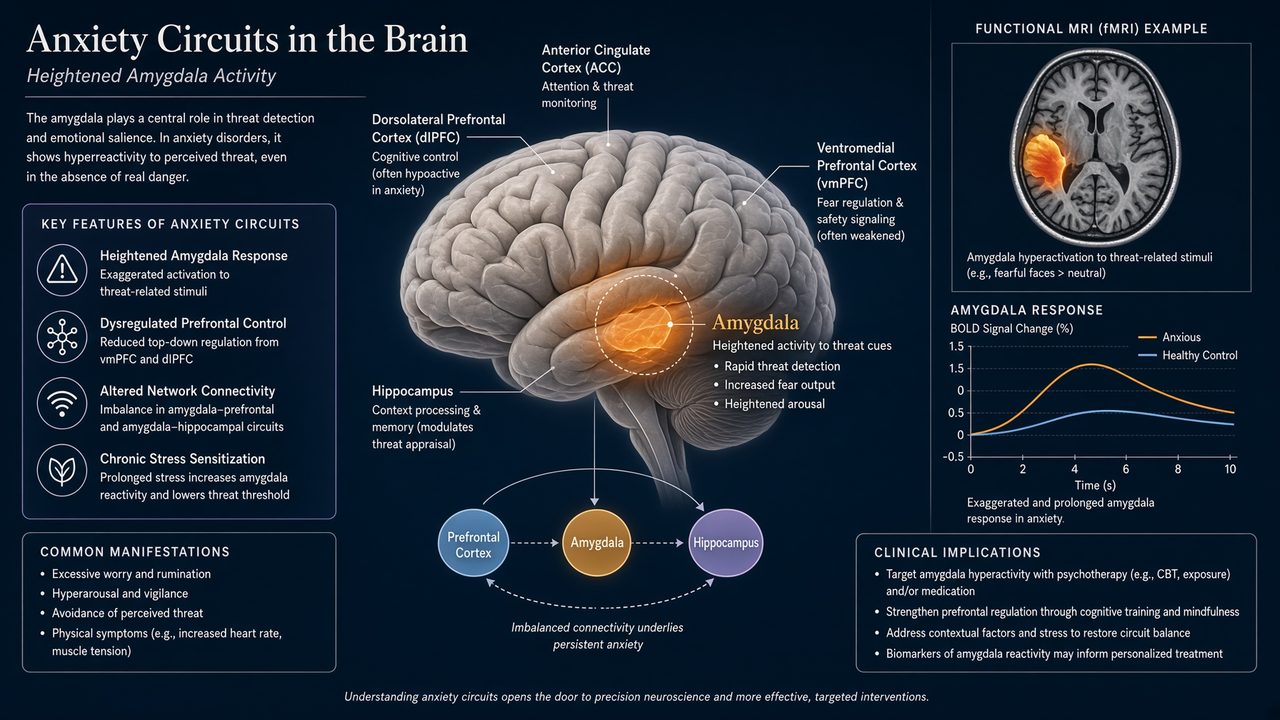
- Ventromedial prefrontal cortex (vmPFC): supports extinction, and signals safety to dampen the amygdala. Reduced vmPFC activity is associated with poor extinction recall.
- Dorsolateral and ventrolateral prefrontal cortex: support cognitive regulation strategies, such as reappraisal.
- Anterior cingulate cortex: monitors conflict and modulates fear expression.
- Inhibitory interneurons and intercalated cells in the amygdala gate fear output.
- Neurochemicals: GABA provides inhibition, and benzodiazepines enhance it. Serotonin, noradrenaline, endocannabinoids, oxytocin and BDNF shape fear learning and extinction.
- Safety signals: learning that a cue predicts the absence of threat activates inhibitory pathways.
When regulation fails
In anxiety disorders, PTSD and phobias, studies show amygdala hyperreactivity, reduced prefrontal control, impaired discrimination between threat and safety, and overgeneralization. Chronic stress weakens prefrontal regulation and strengthens amygdala responses.
Strategies that engage regulation
- Reappraisal: reinterpreting the meaning of a situation reduces amygdala activity and fear.
- Affect labeling: putting feelings into words engages the right ventrolateral prefrontal cortex and reduces amygdala activation.
- Exposure: repeated, graded exposure builds extinction memory.
- Slow breathing: engages the parasympathetic system and reduces arousal.
- Mindfulness: observing fear without reacting reduces reactivity and strengthens prefrontal control.
- Exercise, sleep and social support: raise the threshold for fear.
- Perceived control: having a sense of control over a threat reduces fear and engages the vmPFC.
- Medication: SSRIs and other medications reduce anxiety for many, as a clinician can advise.
- Biofeedback: helps people observe and modulate physiological arousal.
- Avoid avoidance: avoiding feared situations prevents learning safety.
Fear across the lifespan
Children and adolescents learn fear quickly but extinguish it less readily than adults, because prefrontal circuits are still maturing, so supportive adults and gradual exposure matter greatly in early life. In older adults, fear regulation can remain intact, though chronic illness, poor sleep and cognitive decline may weaken it. Throughout life, predictable routines, trusted relationships and repeated safe experiences strengthen the pathways that signal that a situation is safe, and they make future fears easier to manage.
Fear versus anxiety
Fear is a response to an immediate, identifiable threat, while anxiety is a more diffuse anticipation of possible harm. They share circuitry but differ in timing and in the roles of the amygdala and the bed nucleus of the stria terminalis, and treatments are often tailored accordingly.
Takeaway
Fear regulation is a learnable skill grounded in brain circuits. Practicing it strengthens the pathways that quiet the alarm.
Further reading from authoritative sources
- National Institute of Mental Health (NIMH)
- National Center for Complementary and Integrative Health (NCCIH)
This article is educational and does not replace advice from a licensed clinician. See the medical disclaimer. Looking for specialist care? Browse the neurology clinic directory.