How the Brain Adapts to Change
Moving house, changing jobs, losing a loved one, becoming a parent or recovering from illness all require adaptation. The brain is designed to adjust, though change can feel stressful and tiring.
Why change is demanding
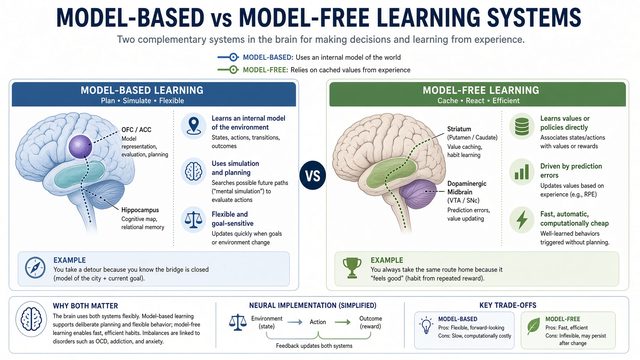
The brain prefers prediction. It builds models from experience and runs on habits, which are efficient. Change disrupts predictions, so the prefrontal cortex must work harder, attention rises, and the stress response may activate. Uncertainty, in particular, tends to be stressful. Studies by Archy de Berker and colleagues found that uncertainty about whether a painful shock would occur produced more stress than certain shocks. Loss of control and ambiguity can feel more distressing than a known negative outcome.
Neuroplasticity
The brain changes with experience, strengthening connections that are used and weakening those that are not. Learning new routes, skills or languages induces structural and functional changes. Plasticity continues across life, though it is greater in early life. After injuries such as stroke, nearby regions can take over some functions with rehabilitation. Habits, supported by the basal ganglia, can be reshaped by repeating new behaviors in consistent contexts, a process that often takes weeks to months. Research by Phillippa Lally and colleagues found that forming a new habit took an average of 66 days, with wide variation.

Flexibility and coping
Cognitive flexibility, which allows people to shift perspectives and strategies, depends on prefrontal networks. Stress, poor sleep and fatigue reduce flexibility. People who view change as a challenge, not a threat, show more adaptive stress responses, as studies by Jeremy Jamieson on stress reappraisal suggest. Social support, a sense of purpose and prior experience coping with change help.
Common reactions
Changes in mood, sleep, appetite and concentration are common during major transitions. Most people adapt over weeks to months. If sadness, anxiety or insomnia persist or interfere with daily life, professional help is advisable.
Strategies
- Prioritize sleep, exercise and nutrition, which support adaptation
- Break change into small steps, and focus on what you can control
- Keep some routines stable, such as bedtime or morning habits, as anchors
- Seek information to reduce uncertainty
- Reframe: consider what you can learn and gain
- Lean on others, and share your feelings
- Practice mindfulness to tolerate uncertainty
- Be kind to yourself, and expect setbacks
- Celebrate progress
- Use rituals to mark transitions
- Seek therapy or counseling for major life stressors
Adapting to change in later life
Older adults facing retirement, moves or bereavement benefit from maintaining routines, learning new activities and staying socially connected. Studies of successful aging highlight flexibility and purpose as protective factors.
Adapting after illness or injury
Rehabilitation uses repeated, goal-focused practice to retrain the brain. Progress often comes in steps, with plateaus along the way. Celebrate small gains and adjust goals with your care team.
When change is forced on you
Unwanted change can bring grief. Allow yourself to feel it, find meaning when possible and accept help from others.
Takeaway
You are wired to adapt. With rest, support and small steps, change becomes growth.
Further reading from authoritative sources
- National Institute of Mental Health (NIMH)
- National Institute of Neurological Disorders and Stroke (NINDS)
This article is educational and does not replace advice from a licensed clinician. See the medical disclaimer. Looking for specialist care? Browse the neurology clinic directory.