How the Brain Responds to Group Belonging
People naturally form and join groups, from families and teams to nations and fandoms. Group membership influences how we feel, think and act, and the brain has mechanisms to support it.
Why belonging matters
Evolutionary psychologists argue that cooperation in groups was essential to survival. Roy Baumeister and Mark Leary proposed that belongingness is a fundamental human need, and its lack is linked to distress. Group membership offers support, shared identity and meaning.
Brain responses to groups
- Reward: shared success, group approval and rituals engage the striatum.
- Self-related processing: the medial prefrontal cortex is involved in thinking about oneself and close others, and in some studies it responds to in-group identity.
- Empathy: people tend to show stronger empathic responses to in-group members in some studies, which can be altered by context.
- Memory: people remember in-group faces better, called the own-group bias.
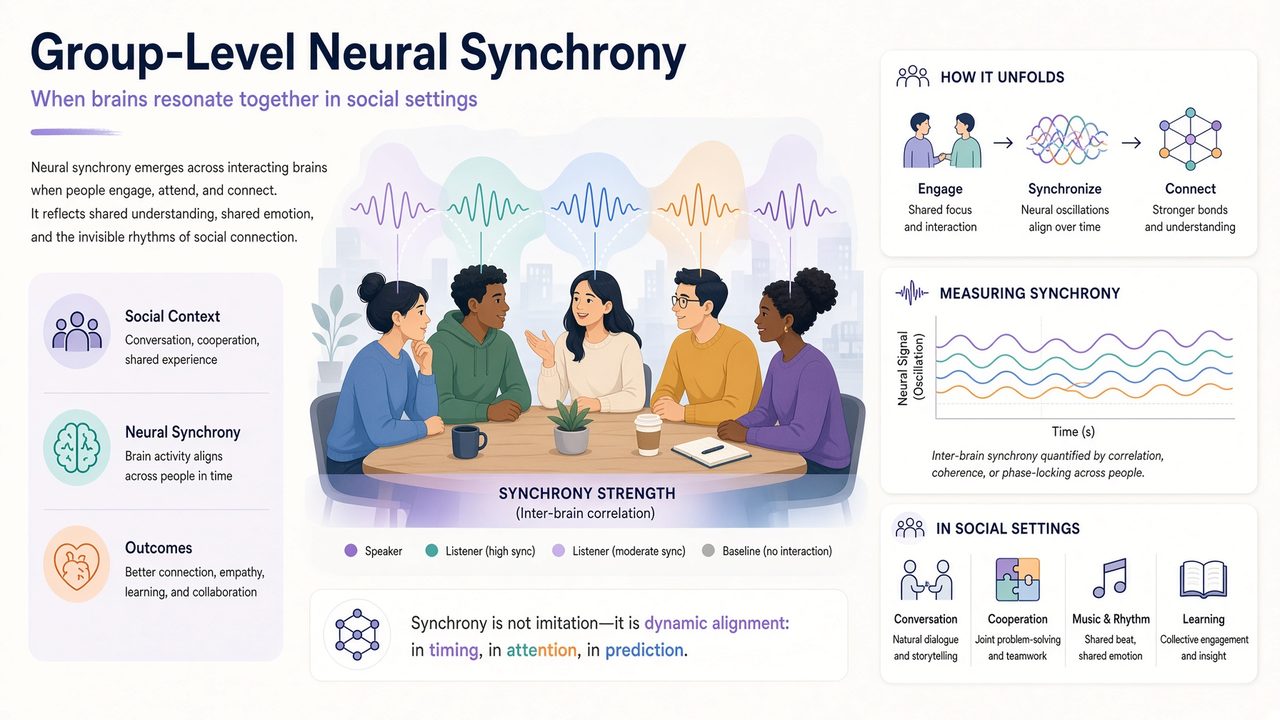
- Neural synchrony: group members engaged in shared activities, such as music or sports, show more synchronized brain and body rhythms.
Oxytocin
Studies by Carsten De Dreu and colleagues suggest that oxytocin can increase cooperation within groups and may also increase defensive aggression toward out-groups in some conditions, which suggests it supports group bonding more than universal kindness. Findings are context-dependent.
Identity and wellbeing
Strong identification with groups can improve wellbeing, resilience in illness and recovery from trauma, as research on the social identity approach shows. Belonging to multiple groups seems especially protective. Losing groups, as in retirement or bereavement, can reduce wellbeing.
Risks
- Conformity: Solomon Asch's experiments showed people often agree with a group even when it is wrong, and brain studies show that disagreeing with the group activates error-related regions.
- Groupthink, where cohesion suppresses dissent
- Bias and conflict between groups
- Radicalization in extreme groups, which can offer belonging, identity and purpose to isolated people
- Exclusion of outsiders
Healthy belonging
- Belong to several groups with different people and values
- Encourage dissent and diverse views
- Keep an identity beyond one group
- Seek contact across groups
- Evaluate groups for respect, honesty and freedom to leave
- Provide inclusive spaces for newcomers
Teams, fans and online groups
Sports fans show strong emotional responses when their team wins or loses, and studies find that hormone levels such as testosterone can shift with outcomes. Online communities can offer belonging, but algorithms may also reward outrage and polarization. Groups with clear norms of civility and openness tend to be healthier.
Leaving a group
Leaving a group, whether a job, religion, friendship circle or community, can feel like a loss of identity. People often benefit from support, new connections and time. Recognizing that the pain of leaving reflects how important belonging is can make it easier to rebuild.
Teaching children about belonging
Children thrive when they feel included at home and school. Adults can model welcoming behavior, invite children into varied groups and discuss fairness. Learning to disagree respectfully while remaining part of a group is a valuable skill for life.
Takeaway
Belonging is deeply rewarding, and it works best when groups stay open, diverse and respectful.
Further reading from authoritative sources
- National Institute of Mental Health (NIMH)
- National Institute of Neurological Disorders and Stroke (NINDS)
This article is educational and does not replace advice from a licensed clinician. See the medical disclaimer. Looking for specialist care? Browse the neurology clinic directory.