Stem Cells and Brain Repair
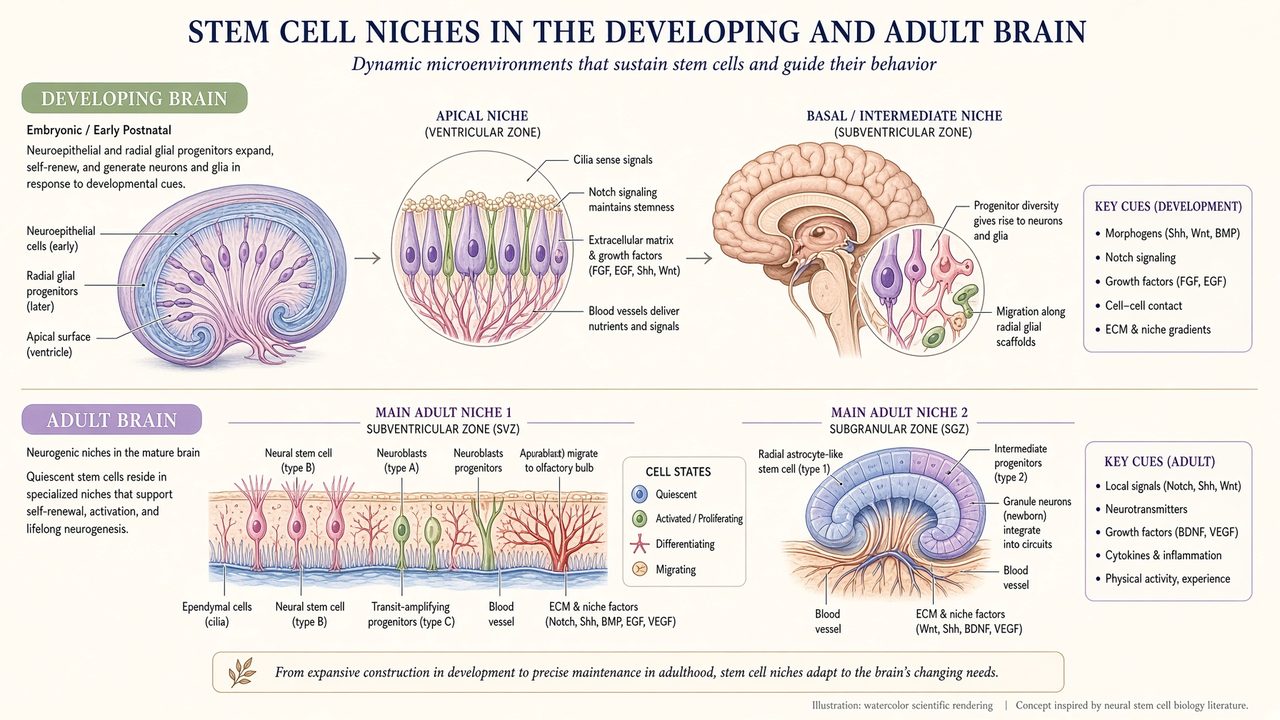
The idea of replacing lost brain cells is powerful. Stem cells can become many cell types, and researchers are testing whether they can rebuild or support damaged nervous system tissue. Real progress is happening, but it is slower and more complicated than advertising suggests.
Types of stem cells
- Embryonic stem cells: pluripotent cells that can become any cell type, used to generate specific neurons in the lab.
- Induced pluripotent stem cells: adult cells, such as skin cells, reprogrammed to a stem-like state, discovered by Shinya Yamanaka, who shared a Nobel Prize in 2012. They allow patient-matched cells and disease modeling.
- Neural stem cells and progenitors: cells already committed to a nervous system lineage.
- Mesenchymal stromal cells: from bone marrow or fat, which may release supportive factors but do not appear to become neurons.
How they might help
- Cell replacement: replacing lost neurons or glia, for example dopamine neurons in Parkinson's disease or oligodendrocytes in spinal injury.
- Trophic support: secreting growth factors and anti-inflammatory signals.
- Modulating immunity and inflammation.
- Disease modeling and drug discovery: growing patient-derived neurons in dishes, and brain organoids, to study disease. This is currently the most mature use.
Where research stands
- Parkinson's disease: trials in Japan and the United States are transplanting dopamine-producing neurons derived from iPSCs or embryonic stem cells into patients. Early reports published in Nature in 2025 described safety and signs of cell survival, though effectiveness remains under study. Earlier fetal tissue transplants gave mixed results, including dyskinesias in some patients.
- Stroke: early trials of various cell types show safety and some signals, with benefit unproven.
- Spinal cord injury: trials of neural progenitors and other cells are ongoing, with modest results so far.
- ALS, MS and Alzheimer's: small trials have explored mesenchymal and neural cells, and none has established clinical benefit.
- Retinal disease: cell therapies for macular degeneration are in trials, and illustrate how nervous system tissue can be targeted.
Challenges
Cells must survive, integrate into circuits, connect correctly, avoid immune rejection and not form tumors. Replacing lost neurons in widespread diseases like Alzheimer's is especially difficult because damage affects many cell types and areas. The environment of a diseased brain can also harm transplanted cells.
Beware of unproven clinics
Hundreds of clinics around the world sell stem cell injections for Alzheimer's, autism, stroke and other conditions without evidence, often at high cost. Patients have suffered infections, tumors and other injuries. The International Society for Stem Cell Research advises asking whether a treatment is part of an approved clinical trial, whether it has regulatory approval, and what evidence supports it. Be cautious of promises of cures and testimonial-driven marketing.
Questions to ask about any trial
Ask who sponsors the study, whether it has ethics board approval, whether participants are randomized, what the risks are, who pays for treatment and follow-up, and what happens if there are complications. Legitimate trials do not charge patients large fees to receive an experimental treatment. Your neurologist can help you find and weigh options.
Takeaway
Stem cell science is a promising frontier for brain repair, but today it is mostly research. If you are interested, look for legitimate clinical trials and talk to your neurologist.
Further reading from authoritative sources
This article is educational and does not replace advice from a licensed clinician. See the medical disclaimer. Looking for specialist care? Browse the neurology clinic directory.