Short-Term vs. Long-Term Memory: What's the Difference?
Memory is not one thing. Psychologists and neuroscientists distinguish systems that hold information for seconds from those that preserve it for a lifetime. Understanding the difference explains why you can forget a phone number moments after hearing it, yet remember your childhood home decades later.
Short-term memory
Short-term memory holds a small amount of information for roughly 15 to 30 seconds unless it is rehearsed. In 1956, George Miller proposed a capacity of "seven plus or minus two" items, though modern researchers estimate that people can actively hold about four chunks of information. A chunk can be a single digit or a meaningful group, such as a familiar word or area code, which is why chunking makes lists easier.
Working memory
Working memory extends the idea. It does not only store information but manipulates it, as when you do mental arithmetic or hold a sentence in mind while reading on. It is supported mainly by the prefrontal and parietal cortex and is critical for reasoning and comprehension.
Long-term memory
Long-term memory has an apparently unlimited capacity and can last a lifetime. It includes:
- Explicit (declarative) memory, which you can state: episodic memory for personal events and semantic memory for facts
- Implicit (nondeclarative) memory, which shows up in behavior, such as skills, habits and priming

Different brain systems
The hippocampus and surrounding medial temporal lobe are essential for forming new explicit long-term memories. Over time, memories become less dependent on the hippocampus and more distributed across the cortex, a process called systems consolidation. Skills rely on the basal ganglia and cerebellum, and emotional associations involve the amygdala.
The famous patient H.M., who had both medial temporal lobes removed in 1953, kept relatively normal short-term memory and old memories but could not form new long-term explicit memories. This dissociation provided strong evidence that the two systems are distinct.
How information moves from short to long term
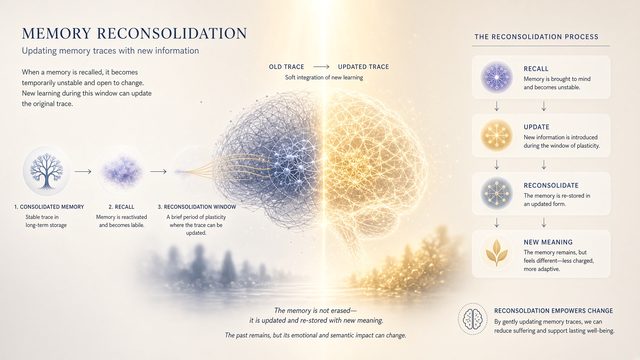
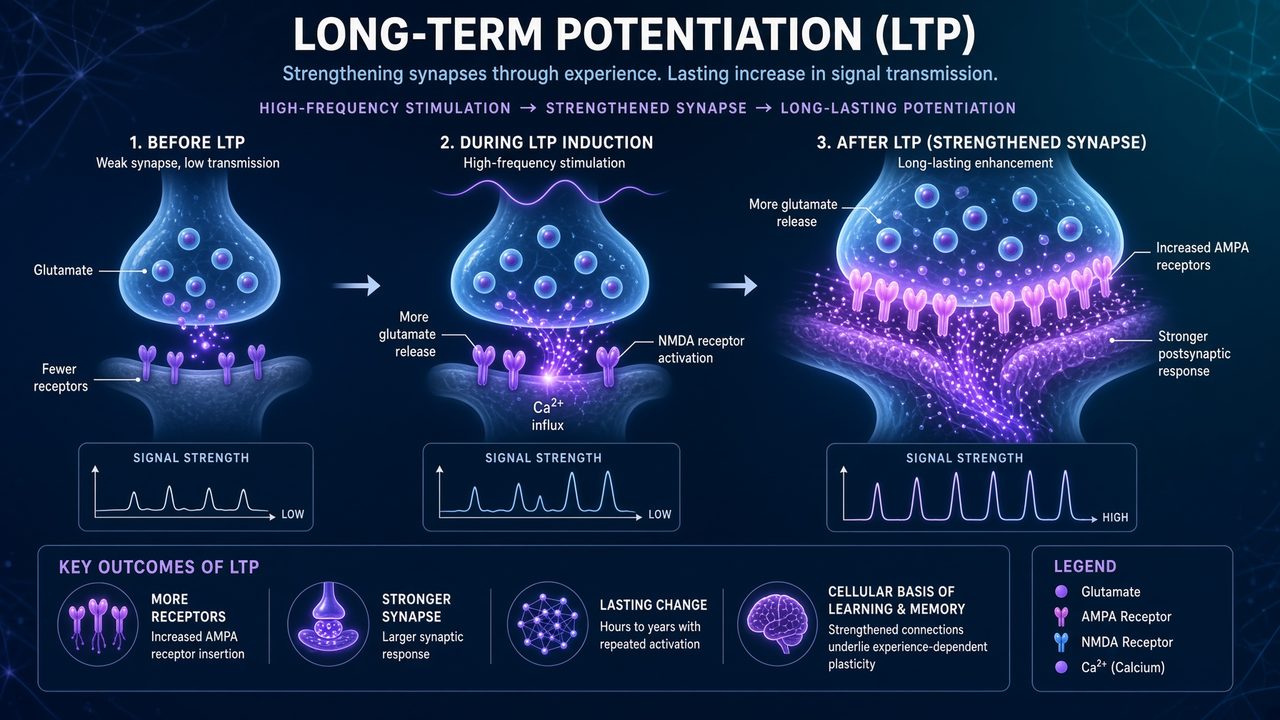
1. Attention. You must notice the information. 2. Encoding. The brain processes its meaning, sound or appearance. Deeper, meaning-based processing produces stronger memories. 3. Consolidation. Synaptic changes stabilize over hours, and systems consolidation proceeds over days to years, with sleep playing a key role. 4. Retrieval. Recalling a memory can strengthen it and also make it temporarily changeable.
Why we forget
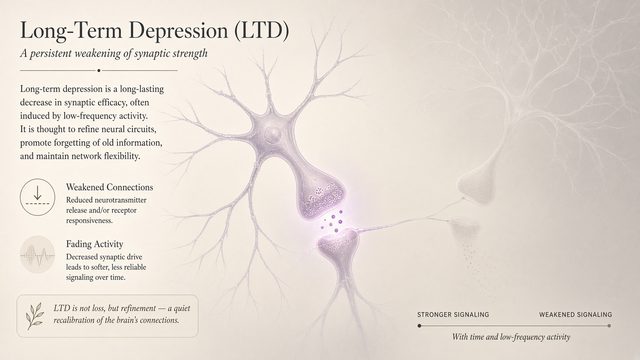
Short-term items fade or get displaced by new information. Long-term memories can be lost through failures to encode, weak consolidation, decay of traces, interference from similar memories, or an inability to retrieve cues that would trigger them. Often the memory exists but access fails, as in the tip-of-the-tongue experience.
Tips for strengthening both
- Chunk information into meaningful groups.
- Process deeply. Connect new facts to what you already know.
- Space your practice over days instead of cramming.
- Test yourself rather than just rereading.
- Sleep. Memory consolidation occurs during sleep.
- Use visual imagery and stories to link items.
- Reduce multitasking, which impairs encoding.
- Exercise and manage stress, both of which influence hippocampal function.
When memory problems merit attention
Occasional forgetfulness is normal. Seek evaluation if memory lapses are getting worse, interfering with work or daily life, involve getting lost in familiar places, or are noticed by family. Many causes, including sleep problems, medications, thyroid disease and depression, are treatable.
Further reading from authoritative sources
- National Institute of Neurological Disorders and Stroke (NINDS)
- National Center for Complementary and Integrative Health (NCCIH)
This article is educational and does not replace advice from a licensed clinician. See the medical disclaimer. Looking for specialist care? Browse the neurology clinic directory.