Emotional Intelligence and the Brain
Emotional intelligence, often shortened to EI or EQ, describes the ability to recognize, understand and manage emotions in oneself and others. The idea is popular, and the science behind it is more nuanced, with real skills that map onto known brain systems.
What EI is
Peter Salovey and John Mayer defined an ability model of four branches: perceiving emotions, using emotions to facilitate thinking, understanding emotions and managing emotions. Daniel Goleman popularized a broader version that includes motivation and social skills. Ability tests such as the MSCEIT measure performance on emotional tasks, whereas trait measures rely on self-report and overlap with personality.
Brain networks
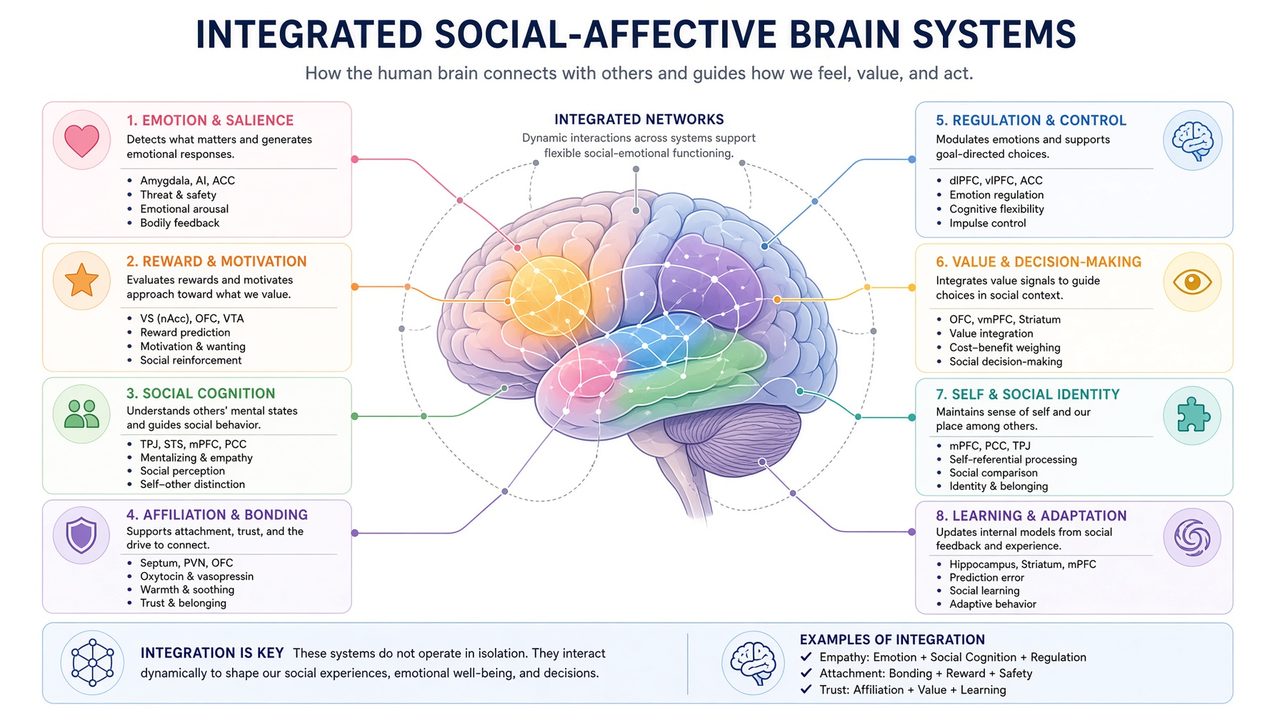
- Perceiving emotion: the fusiform face area, superior temporal sulcus and amygdala process faces and voices, and the insula supports awareness of one's own body signals. People with better interoceptive accuracy often report clearer emotional awareness.
- Understanding others: the medial prefrontal cortex, temporoparietal junction and precuneus support theory of mind, while mirror and empathy networks in the inferior frontal gyrus, insula and anterior cingulate support emotional resonance.
- Understanding emotion concepts: Lisa Feldman Barrett's theory of constructed emotion proposes that people with richer emotional vocabulary, known as emotional granularity, differentiate states more finely, which is associated with better regulation.
- Managing emotion: lateral and medial prefrontal regions regulate the amygdala through reappraisal, suppression and attention deployment.
- Damage studies: patients with ventromedial prefrontal damage, such as those studied by Antonio Damasio, can reason logically but make poor personal and social decisions, indicating that emotion is integral to good judgment.

What research shows about outcomes
- Meta-analyses associate higher ability EI with modestly better job performance, academic achievement, relationship quality and mental health, though correlations are small to moderate after controlling for personality and intelligence.
- Emotional regulation skills are linked to lower depression and anxiety.
- Claims that EQ matters more than IQ for success are not supported by evidence.
- Critics note that the construct overlaps with existing traits, and that measurement problems exist.
Can it be trained?
Yes. Programs of social and emotional learning in schools improve emotional skills, behavior and academic performance, according to a meta-analysis of over 200 studies by Joseph Durlak and colleagues. In adults, training in emotion recognition, mindfulness and cognitive reappraisal improves regulation. Therapy techniques such as dialectical behavior therapy teach emotion regulation skills.
Ways to build emotional intelligence
- Name your feelings precisely: go beyond "bad" to words like disappointed, anxious or lonely. Labeling reduces amygdala reactivity.
- Notice body signals: tension, heart rate, stomach sensations.
- Pause before reacting, using breathing to engage regulation.
- Reappraise: consider alternative interpretations.
- Listen actively: reflect back what you hear and ask open questions.
- Practice perspective taking, reading fiction and seeking diverse viewpoints.
- Read faces and tone, and check your assumptions.
- Seek feedback from trusted people.
- Manage stress and sleep, which erode regulation.
- Reflect daily on emotional events and responses.
- Use mindfulness meditation to build awareness.
Takeaway
Emotional intelligence is a set of learnable skills grounded in brain systems for feeling, understanding and regulating. Practicing them strengthens both inner life and relationships.
Further reading from authoritative sources
- National Institute of Mental Health (NIMH)
- National Center for Complementary and Integrative Health (NCCIH)
This article is educational and does not replace advice from a licensed clinician. See the medical disclaimer. Looking for specialist care? Browse the neurology clinic directory.