Fear Learning and Extinction: The Science of Overcoming Phobias
Why can a single frightening experience create a lasting fear, and why does exposure to the feared thing eventually reduce it? The answers come from decades of research on fear conditioning and extinction, which underlies exposure therapy for phobias, panic and PTSD.
How fear is learned
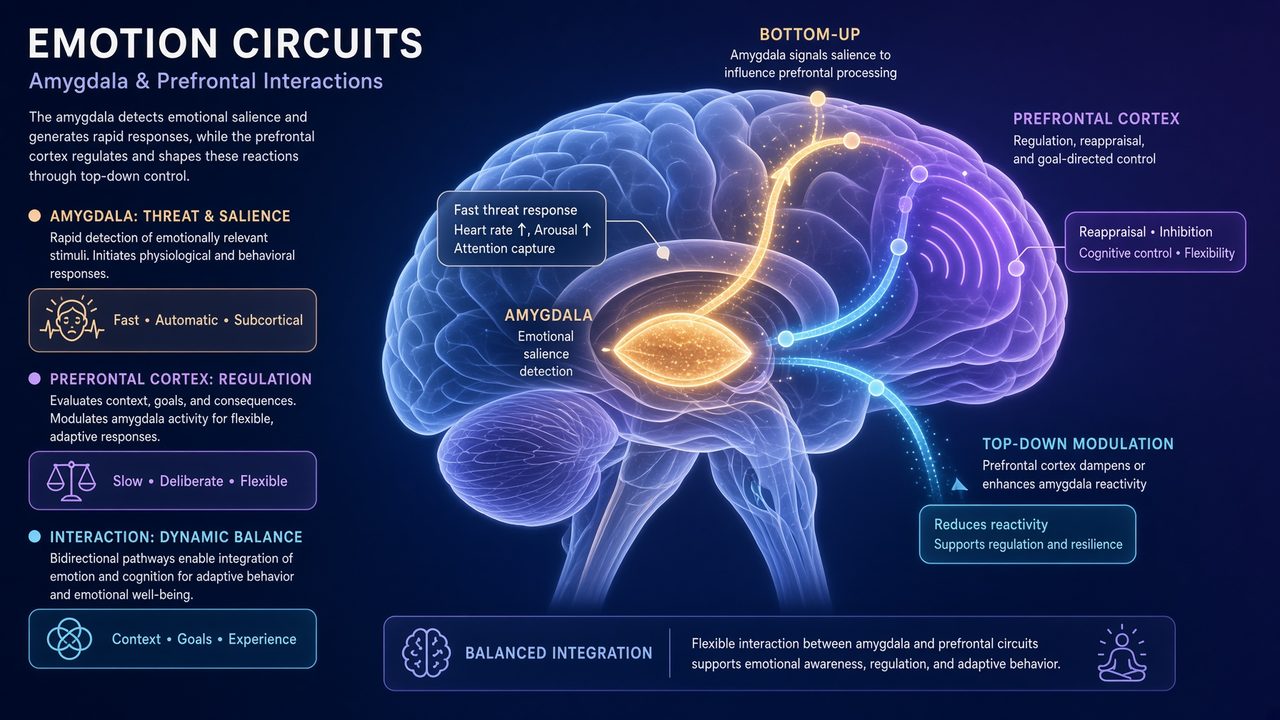
In fear conditioning, a neutral cue, such as a tone, is paired with an aversive event, such as a shock. After a few pairings, the cue alone triggers fear responses. Joseph LeDoux and others traced the pathway: sensory information reaches the amygdala, particularly the lateral nucleus, which links to the central nucleus to produce freezing, heart rate changes and stress hormone release. The hippocampus encodes context, allowing the brain to learn that danger is linked to a particular place. Phobias, such as fear of dogs after a bite, can form through direct conditioning, observing others, or being told about danger.
How extinction works
When the cue is repeatedly presented without the aversive event, the fear response declines. Research by Mark Bouton, Gregory Quirk and Mohammed Milad shows that:
- The original memory remains. Fear can return through spontaneous recovery after time, renewal when the context changes, or reinstatement after a new stressor.
- A new inhibitory memory forms, in which the cue now predicts safety.
- The ventromedial prefrontal cortex helps to suppress amygdala fear output, and the hippocampus provides contextual information on when extinction applies.
- Consolidation depends on sleep and time. Extinction memories are initially fragile.
- Amygdala and prefrontal activity patterns in people with anxiety disorders show reduced prefrontal regulation of extinction.

Exposure therapy
Exposure therapy applies extinction principles. Patients gradually confront feared objects or situations, in imagination or real life, while learning that feared outcomes do not occur. It is among the most effective treatments for specific phobias, social anxiety, panic disorder, OCD and PTSD. Modern accounts emphasize inhibitory learning: the goal is not for anxiety to drop, but for patients to learn that they can tolerate fear and that expected threats do not happen.
Making extinction stick
- Practice in multiple contexts: different places, times and settings reduce renewal.
- Vary the stimuli and intensity, and use expectancy violation: highlight the gap between what the patient expects and what occurs.
- Remove safety behaviors that prevent learning.
- Space practice sessions and rehearse between sessions.
- Use retrieval cues, such as a reminder card.
- Sleep well after sessions to help consolidate learning.
- Reconsolidation approaches: research on briefly reactivating a memory and then extinguishing it within the reconsolidation window has had mixed results in humans.
- Virtual reality exposure offers controlled exposure to flying, heights or social situations.
- Medication: D-cycloserine has been tested as an enhancer, with mixed results. Antidepressants and benzodiazepines are not recommended to be combined with exposure in a way that reduces learning, although decisions about medication belong to a clinician.
What to expect
A therapist builds a hierarchy of feared situations, and the person works through them step by step. Many phobias respond within a few sessions, and even single-session treatments have shown benefit for specific phobias.
Takeaway
Overcoming fear means building a stronger memory of safety. With repeated, varied and supported practice, the brain learns that the feared thing is manageable.
Further reading from authoritative sources
- National Institute of Mental Health (NIMH)
- National Center for Complementary and Integrative Health (NCCIH)
This article is educational and does not replace advice from a licensed clinician. See the medical disclaimer. Looking for specialist care? Browse the neurology clinic directory.