The Science of Empathy: How Brains Share Feelings
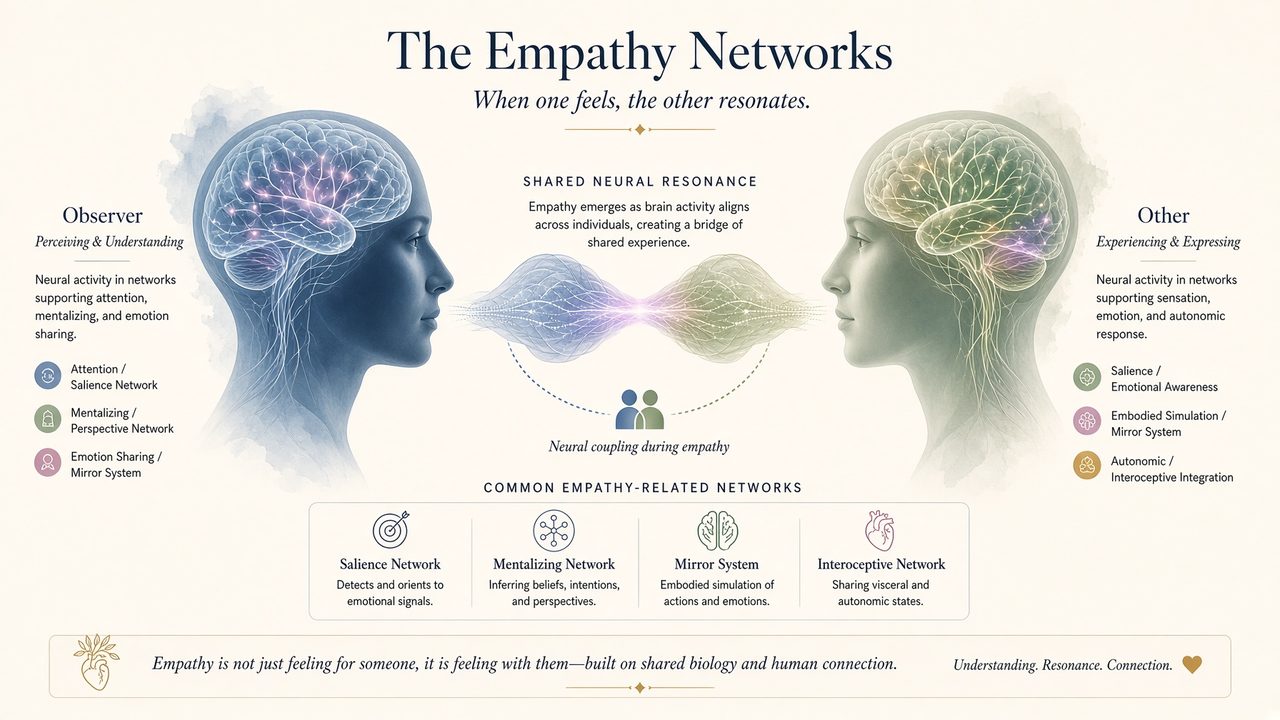
When you wince at someone else's pain or tear up at a friend's good news, your brain is doing something remarkable: representing another person's inner state. Empathy is not one ability but a set of processes, and neuroscience has begun to separate them.
Components of empathy
- Emotional (affective) empathy: sharing another's emotional state
- Cognitive empathy (perspective-taking): understanding someone's thoughts and feelings, also called theory of mind
- Empathic concern (compassion): a caring motivation to help
These can occur separately. A skilled manipulator may have strong cognitive empathy but little concern.
Brain networks
Emotional empathy
Studies by Tania Singer and others found that when people observe a loved one in pain, parts of their own pain network, especially the anterior insula and anterior cingulate cortex, activate, although somatosensory areas do not usually do so. This suggests we share the emotional, not the sensory, aspect of pain.
Cognitive empathy
Thinking about others' mental states recruits the medial prefrontal cortex, temporoparietal junction and superior temporal sulcus.
Mirror neurons
Neurons in monkeys that fire both when performing and observing an action were discovered in the 1990s. Whether the human mirror system underlies empathy is debated. Its role in action understanding is supported, but claims that mirror neurons explain empathy or autism are considered overstated by many scientists.
Compassion
Training studies suggest that compassion involves reward-related and affiliative circuits, and differs from empathic distress, which can lead to burnout.

Modulators of empathy
Empathy is not automatic or equal for everyone. Responses are stronger for people we see as similar, close or members of our group, and weaker for outgroup members or those we blame. Stress, cognitive load and power can reduce empathy. Context and beliefs matter.
Development
Babies show signs of emotional contagion, such as crying when they hear other infants cry. Toddlers begin helping, and perspective-taking develops through childhood. Secure attachment and warm parenting support empathy.
Differences and conditions
- Autism involves differences in cognitive empathy and social communication in many people, but autistic people often experience strong emotional empathy. Some researchers propose a "double empathy problem": mismatches occur in both directions between autistic and non-autistic people.
- Psychopathy is associated with reduced empathic concern and reduced amygdala responses, with relatively intact cognitive empathy.
- Alexithymia, difficulty identifying one's own feelings, is linked with lower empathic accuracy.
Empathy fatigue
People in caring roles may become exhausted by repeated exposure to suffering. Compassion-focused practices, boundaries and support help sustain caring.
Is empathy always good?
Empathy can be biased and can motivate favoring individuals over larger groups. Some philosophers and psychologists argue that deliberate compassion and reasoning are more reliable guides for moral action. Others emphasize empathy's role in connection and prosocial behavior.
Building empathy
- Listen without interrupting and without planning your reply.
- Read fiction, which research links to improved theory of mind in some studies, though effects are modest.
- Seek out different perspectives and relationships.
- Practice loving-kindness meditation, which has been shown to increase positive feeling and may alter brain responses.
- Name emotions in yourself and others.
- Care for your own wellbeing so you have capacity for others.
Further reading from authoritative sources
- National Institute of Mental Health (NIMH)
- National Center for Complementary and Integrative Health (NCCIH)
This article is educational and does not replace advice from a licensed clinician. See the medical disclaimer. Looking for specialist care? Browse the neurology clinic directory.