How Memories Are Formed: Encoding, Consolidation, and Retrieval
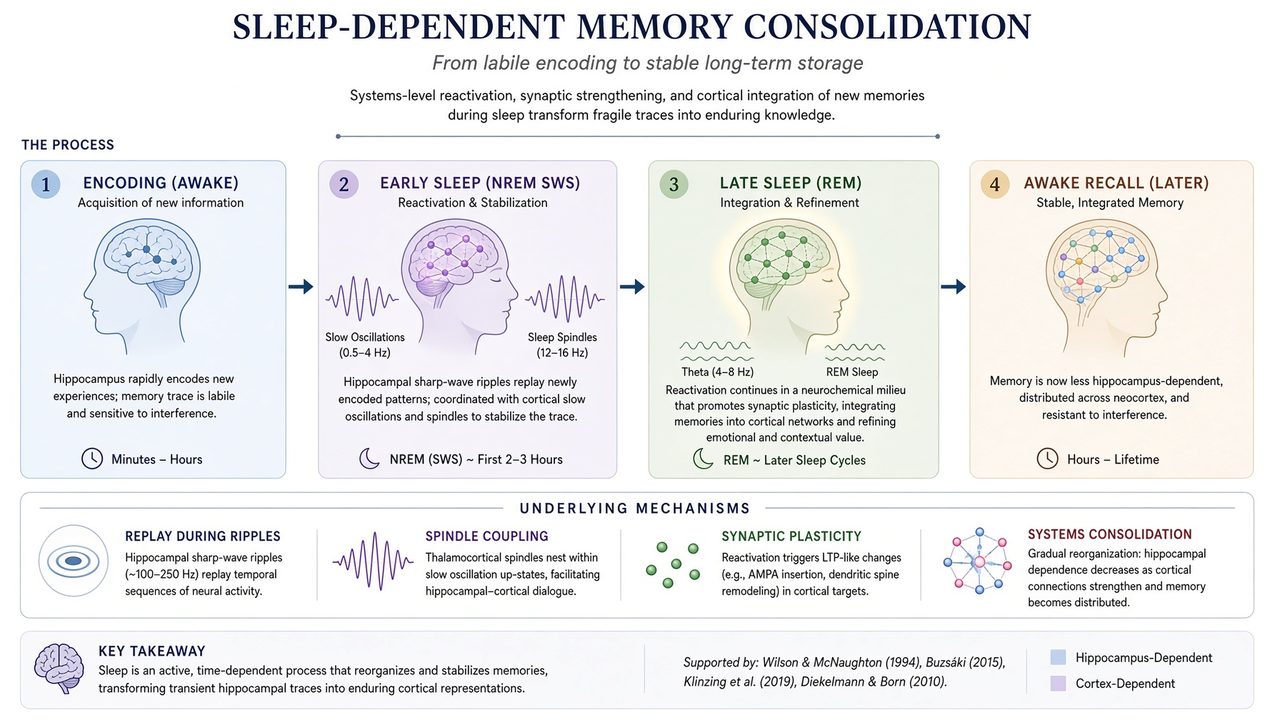
Remembering feels effortless, but behind every memory is a multistep biological process. Scientists describe it in three broad stages: encoding, consolidation and retrieval. Problems at any stage can cause forgetting, which is why memory is better thought of as a process than a single place in the brain.
Stage one: encoding
Encoding is how information first enters memory. It begins with attention. Sights, sounds and thoughts are processed by sensory areas, and information you attend to is passed on to the hippocampus and related regions. Information you ignore usually fades within seconds.
How deeply you process material strongly affects what you remember. Researchers have long found that thinking about meaning, such as how a fact relates to something you already know, produces stronger memories than superficial processing, such as noticing how a word looks. Emotion also boosts encoding. The amygdala responds to emotionally significant events and signals the hippocampus to prioritize them.
Stage two: consolidation
New memories are initially fragile. Consolidation is the process that stabilizes them, and it occurs on two timescales.
Synaptic consolidation
Within minutes to hours, connections between the neurons involved in an experience are strengthened through chemical and structural changes, including new protein synthesis. This is the cellular basis of learning.
Systems consolidation
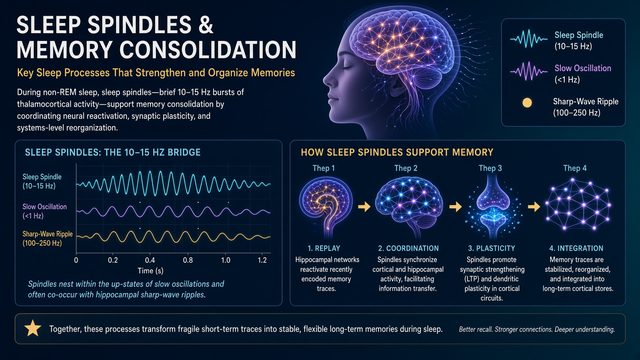
Over days, months and even years, memories become less dependent on the hippocampus and more distributed across the cortex. Sleep plays a major role: during slow-wave sleep the hippocampus appears to replay recent activity, helping the cortex integrate it with existing knowledge.

Stage three: retrieval
Retrieval is the act of bringing a memory back. It works best when cues at recall match cues present during encoding, a principle known as encoding specificity. This is why returning to a place can spark forgotten memories.
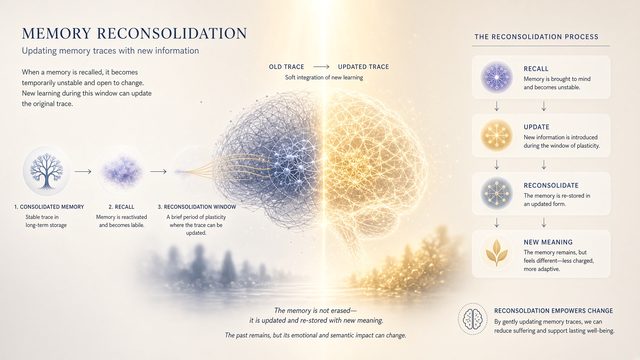
Retrieval is not passive. Each time a memory is recalled, it becomes temporarily malleable and is then stored again in a process called reconsolidation. This may allow memories to be updated with new information, but it also means details can shift over time or be influenced by suggestion.
Types of memory involved
- Sensory memory holds raw impressions for a fraction of a second.
- Working memory keeps information active for seconds while you use it.
- Long-term memory includes explicit memories of facts and events and implicit memories such as skills and habits.
Different brain regions support each type, with the prefrontal cortex central to working memory, the hippocampus to new explicit memories, and the basal ganglia and cerebellum to skills.
Why we forget
Forgetting has several causes: information was never encoded because attention was elsewhere, a memory was not consolidated, retrieval cues are missing, or competing memories interfere. Some forgetting is adaptive, since clearing out unneeded details helps the brain focus on what matters.
Making memories stick
Evidence-supported strategies include:
- Pay full attention while learning. Multitasking weakens encoding.
- Connect new information to what you know, using examples, stories and mental images.
- Test yourself instead of rereading, since retrieval practice strengthens memory.
- Space out practice across days rather than cramming.
- Sleep after studying. It helps consolidate what you learned.
- Exercise regularly. Aerobic activity is associated with better memory function.
When memory problems are a concern
Everyone forgets names or misplaces keys. If memory lapses are frequent, getting worse, or interfering with work or home life, talk with a doctor. Many treatable conditions, including thyroid problems, vitamin B12 deficiency, depression, sleep apnea and medication side effects, can affect memory.
Further reading from authoritative sources
- National Institute of Neurological Disorders and Stroke (NINDS)
- National Center for Complementary and Integrative Health (NCCIH)
This article is educational and does not replace advice from a licensed clinician. See the medical disclaimer. Looking for specialist care? Browse the neurology clinic directory.